I am thinking about Alder fixing nitrogen at the roots next to the flowing, swirling river. They are in symbiosis with all realms of friendly powers to do this. True.
Fixed, rooted, “they have figured how to live trapped into place,” says one of Richard Powers’ characters in Overstory.*
They are stillness in the ground, and unable to outrun us. They are vulnerable to pestilences, including our terrible machines. They evolved to be hardened, poisonous and giant to all who may assault them, yet they are losing this race brought upon them. True.
Are they really so fixed?
I am listening to Alder, intently. With their belly in the ground, their body and limbs above, defying gravity, and their thousands of faces — leaves, buds– turned patiently towards the sky, I am quiet; present. Sixty years staring at the sky, as we spin on our axis, and around the Sun, and around the Milky Way’s tiny, dense, black hole, and away from whatever lays at the centre of the universe, riding on dark matter at ever-increasing speed.
Alder says they don’t know the meaning of stillness. It’s not in their vocabulary, so rooted are they in this cosmic dance. Neither do their symbiotic messengers know such stillness. We are all constantly moving. In Spring, look up towards the Sun and the stars, just like the unfurling leaves.
Alder’s DNA, their being, floats all the way up to high cirrus, and thousands of miles, and years.
I think I’d like to be a part, if they’ll allow it.
~~~~~~
Alder pronouns: they, them, theirs. They are monecious, hermaphroditic, so until I can hear them say their pronouns…
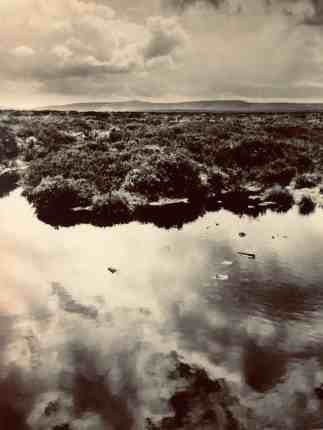
Is it possible to forge a new kind of relationship with the ecological community we in English call, perhaps, unceremoniously, peat bog?
Here in cool Britannic islands, peat has been forming since the last Ice Age, when luminous green mosses took over the quagmire. Fibrous layers of arrested entropy are fuelled by the surfacing of a froth of bryophytes, metabolizing through an exchange of oxygen with carbon dioxide, sunshine for sugar, nutrients, bacteria, and plenty of water. As each generation and their symbiotic partners die down, the decay is slow but sure in locking in carbon. Like snow transforms to glaciers, the dead are pressed down by the weight of the living into an airless solidity. If locked under rocks for millions of years, this is the stuff of crude oil.
At a tender accumulation of just 1mm per year, the process is slower than slow. In the slow period of human evolution, cutting peat to burn and grow food seemed just a nibble around the edges. But now, in full Anthropomode, the extraction is leviathan; industrialized, packaged, and shipped in plastic wraps to a peak of ignorance.
Peat bogs, high and low across continents, are keystone ecosystems in the slowing of the flow of planetary carbon. The absorptions are remarkable, storing more than all other vegetation communities in the world, combined (IUCN). At 6% of the total anthropogenic greenhouse gas emissions into the atmosphere, their degradation has a profound effect on warming.
As with all living systems classified in English, the words “peat” and “bog” together seem somewhat inadequate in describing the exquisite symbiosis and delicate processes of interconnectedness in these places ~ the kind of life-love I call Fluminism. These processes, in the name of a tiny minority of humans earning a living, are now being destroyed like there’s no tomorrow; cut, ploughed, burned, dried, stolen, degraded, and eroded. The critical second law of thermodynamics in living systems, otherwise known as entropy, is unleashed. A steadier state of life-creating disequilibrium (Margulis/Lovelock) becomes a gaping hole of profound loss.
Sphagnum Moss. Photo by me.
If ever there was a time when we ought to value natural processes capable of locking millions of tons of carbon into the ground, it’s now.
The invaluable emerald and gold communities of mossy production, which required such a delicate intersection of topographic, geochemical, climatic, and biological variabilities to begin, are vanishing.
An increase in entropy accounts for the irreversibility of such natural processes, an asymmetry in states from past to future ~ and in some cases the changes are irreversible. Even the hoof-fall of a flock of sheep can sear through a peat bog, triggering expanding evaporation of moisture that will degrade this ancient semi-closed system.
Globally, human cultures have aligned these atmospheric places of slow carbon burial with ghostly mythologies, perhaps a subconscious, spiritual warning to keep our ancestors from ruining these critical ecosystems. They are deemed eerie, often misty by the nature of transpiration of wetlands as if belonging only to lost souls and fuzzy apparitions.
Partly responsible are the will-o’-the-wisps or the ignis fatuus (giddy flames), documented and told in stories by many different human cultures around the globe. The Welsh, for instance, traditionally described the light as Fairy Fire held in the hands of mischievous goblin-fairies or nature sprites (think of William Shakespeare’s Puck) named Pwca*, who would mesmerize and lure travellers off their paths, only to extinguish the flames and leave folk abandoned and utterly lost.
We modern folk of the Westernish have forsaken such myths in favour of science and concluded the oxidation of phosphine, diphosphine and methane can cause photon emissions that can also ignite on contact with oxygen in the air. If there are bubbles of methane about, these too can ignite, and all the myths and hocus pocus are burned up into the atmosphere along with reverence and fear.
I cannot seriously suggest that conjuring a new state of fear for the precious and vibrant matter (Jane Bennett) of peat bogs will save them. But maybe love, reverence and celebration could.
When all the most technical minds are searching for ways of trapping carbon from the atmosphere, it seems utterly foolish to ignore the sphagnum mosses and their partners as a true commonwealth in the slowing, dampening, and sequestration of dangerous climate change. Maybe we can begin by joining together to form a Union of Concerned Peat Bog Lovers, or The Great Sphagnum Mossites, the Emerald and Golds, or simply The Pwca Tribe, to write and tell stories about the magnificence of the processes involved, to create an annual Festival of learning near each place, and to take time to join in reverence, celebration and protection.
Suggestions welcome, as always.
*It is thought Shakespeare may have learned of local Welsh folklore from a friend Richard Price of the priory of Brecon. Could Cwm Pwca and the beautiful Clydach Gorge be the original setting for Midsummer’s Night’s Dream?


 Seasonalight
You must be logged in to post a comment.