It is slightly galling to learn that The Philosopher Fish by Richard Adams Carey has won The Bookseller’s Diagram Prize for the oddest book title. As an ecophilosopher who has written about sturgeon during my PhD Literature of Place studies, I felt it timely to publish my mini-treatise.
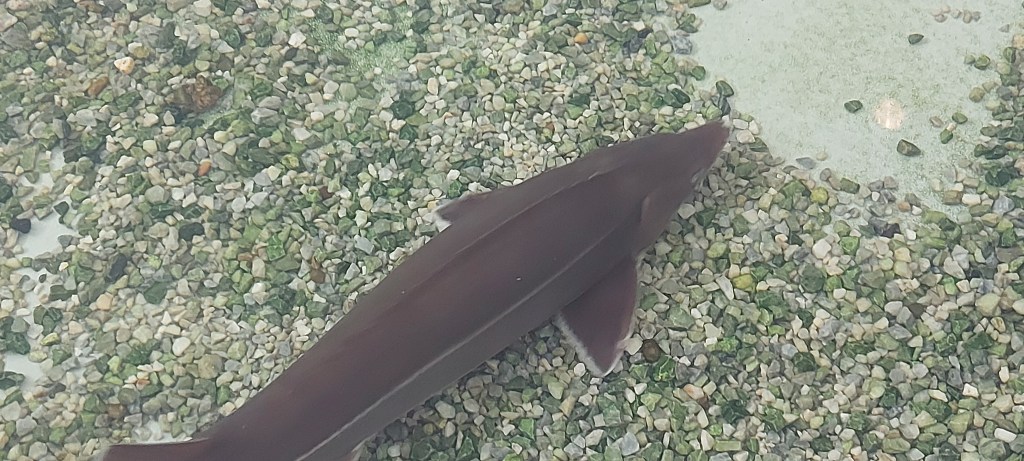
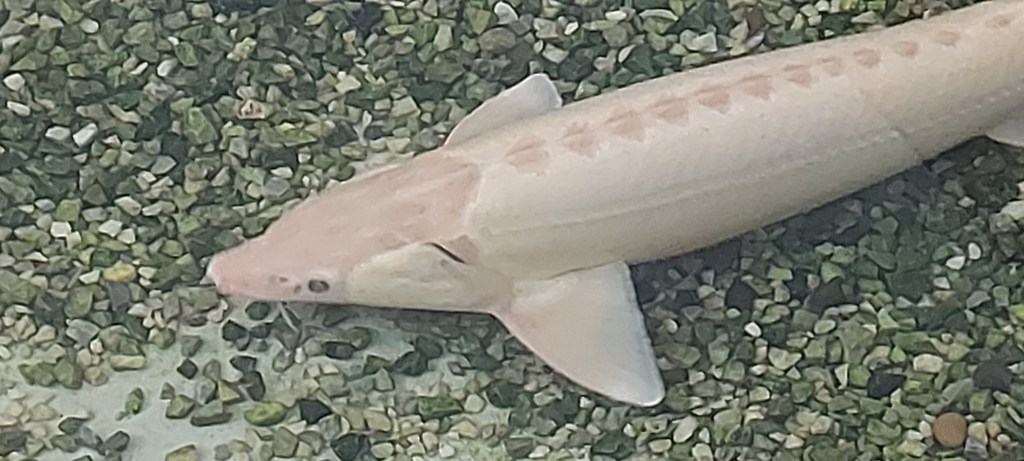
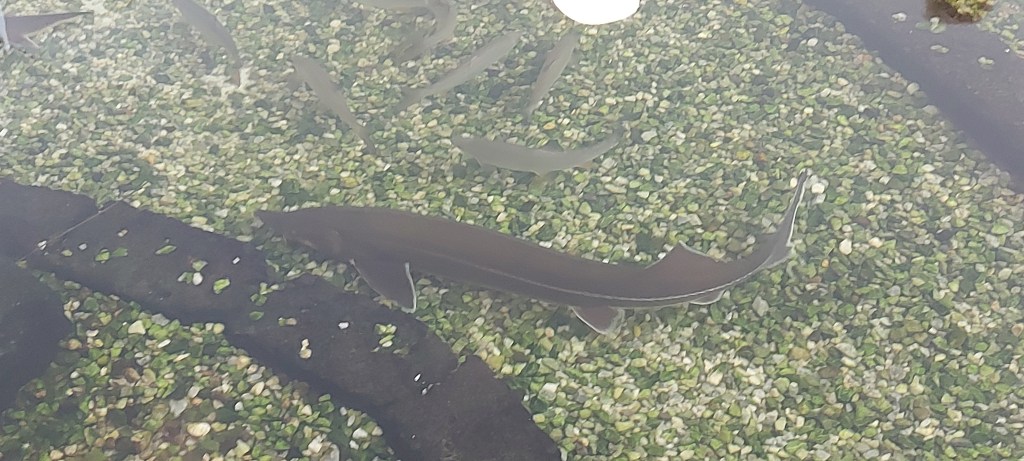
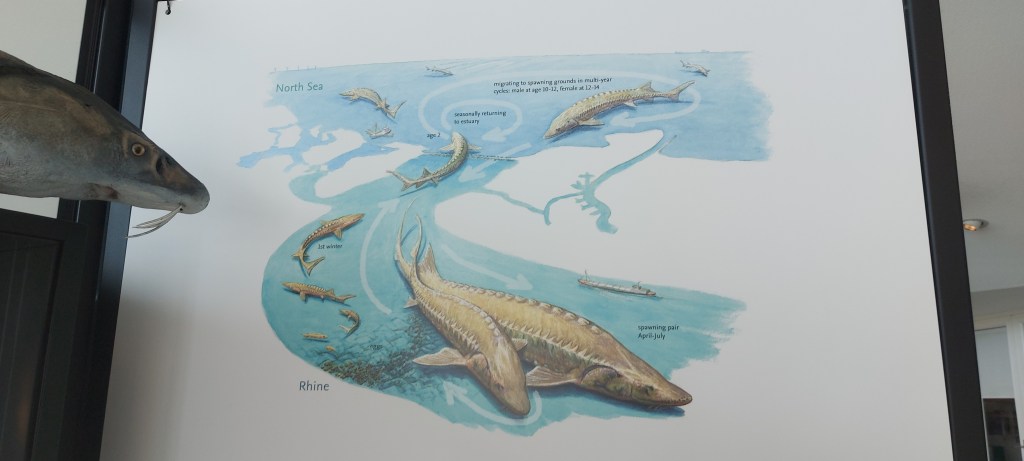
When I wrote the following oddness, call it a “research breakthrough,” (excerpt from Chapter Severn, Rivering), to observe sturgeon ‘in the flesh’ seemed like a pipedream. But last year I was surprised to find a small display of youngsters in an indoor pond at the otherwise fabulous Biesbosch Museum near Dordrecht, Netherlands. Despite welfare concerns, I took the opportunity to observe their sublime and ancient movement through water and hoped one day for their return to the wild, unlimited. The island upon which the museum is built was created by digging channels to provide outflow in the process of the vast depoldering project at Noordwaard. Polder construction, along with fishing, was a major reason why sturgeon were extirpated by humans from the region. Now this vast and largely fluministic intervention, the largest of the Dutch Government’s “Room for Rivers” infrastructure policy, has offered a chance for their return to this National Park aside the beavers.
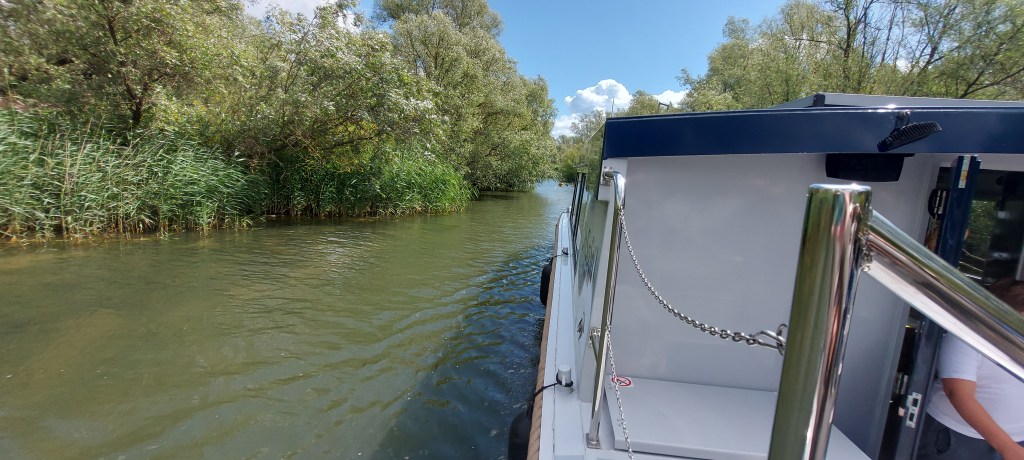
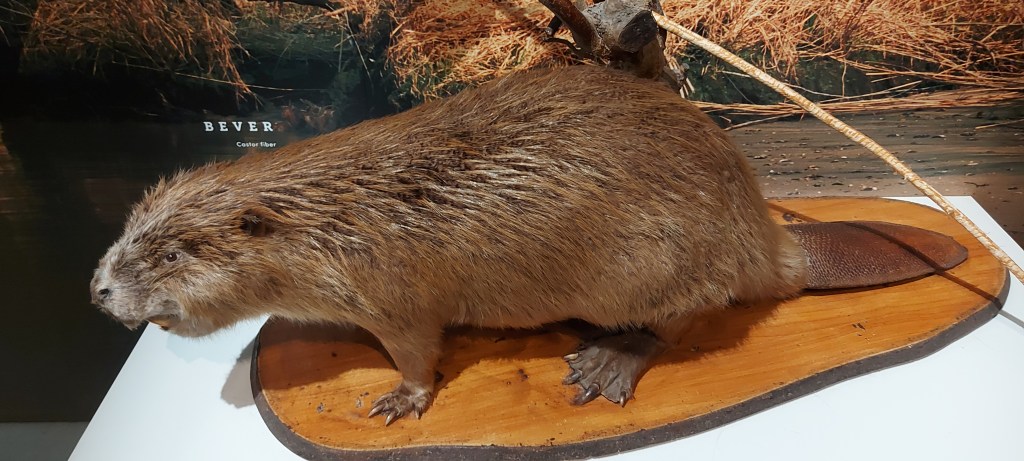
Note: living beavers at home were whom I had originally intended to visit during a boat trip. But to prevent such human voyeurism is their endearing habit! The boat trip failed to find one though, gratefully, I did see evidence of their wondrous fluministic activities.
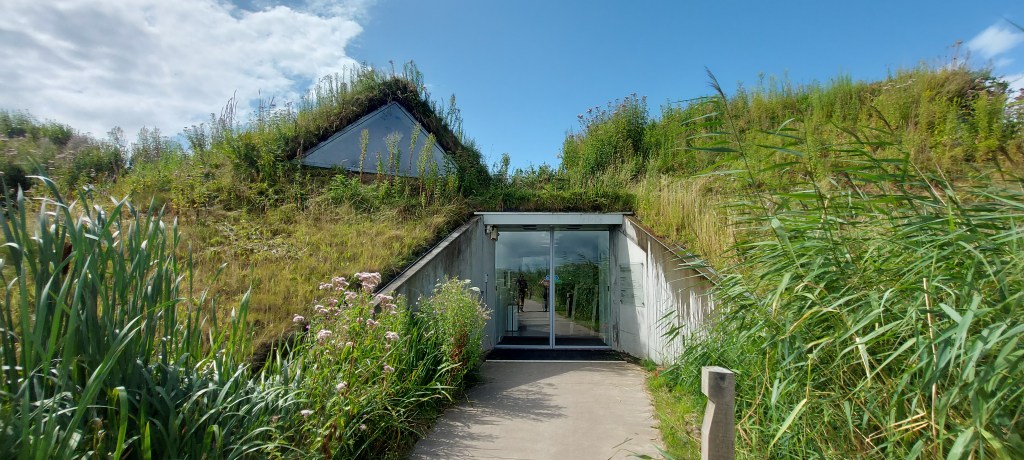
Biesbosch Museum, with its award winning “green roof” architecture and more natural landscaping, is designed by Studio Marco Vermuelen, and the internal exhibition spaces, including displays on the natural/unnatural history of sturgeon, are by Studio Joyce Langezaal. Please find my photos below.
~~~
“The Wye does not end or begin at the mouth. All the way from those springs in the Cambrian hills, evaporating and extracted, it is both part and feeder of the swirling nagorasphere. What is carried in its flow by gravity to this dynamic turbidity in the estuary is cycled by the smallest of beings and turned into a festival for all beings: those that live or visit this place, those that shield here to grow from vulnerable to strong; those who are touched by its protective storm-buffering and surge-quelling. The matter of the basin—the huge lasso of the Wye—is swept here by rains and floods and held in suspension on top of the saltwater, pushed around the peninsula and sucked back towards the oceans by the tides. Time and time again, they mix all of us under the bridge and back until we, and all our junk, are mud banks, sandbanks and longshore drift. Here in the flow that switches east to west and west to east, with the weight and wobble of both the moon and the Earth, the ebb current to seaward and flood current to landward, filling the mouths and the lower reaches of all the rivers that drain here with salt and the anadromous fish at high tides who swim upstream since our Silurian to spawn like king salmon and their parasitic dependents, the ancient sea lampreys, and the catadromous fish at low tides, who swim down the rivers to be unleashed into the great oceans to spawn like the eels, mullet and flatfish flounder.
~~~
European sturgeon, redlist critically endangered anadromous species, ghost to our rivers. But now, once again, curiously visiting our estuaries. Stay with us. Live with us.
Bat’Umi, Basel, Fethiye, Toulouse, Reykjavik, Tangier.
Way below the plate glass of the cities, deep in the rivers, your unfamiliar body winds upstream under the night lights. I can just make out your huge dead body in silver nitrates, museum plates of iron and steel greys next to all those proud, fading men.
Your underwater knowing is as old as the triassic cliffs on these Severn Estuary edges, my spectral kin. Like smooth-hounds and thornback rays, flick your strong fossil tail for that exquisite downward force, shimmering from tide to river and back with the burning electrosensitivity of your upturned beak, running along those beautiful lateral lines.
Swimming in from the depths of the sea, you stay in Winter to syphon the bottom of the estuary with your soft mouth, tasting for shelled morsels and goby enzymes with your long barbels and electroreceptors. Mine is the quietest of observations; yours is a full more-than-human sensory devotion of self that is the whole river-estuary-marine continuum; an internal blueprint of the movements required to get from where you are now, the bed mud and bristle worms, to the fine river grit at the foothills of the mountains when you are old enough, to where you’ll gather in oxygenated pools to leave your young. Then, to twist through a meander with a freshwater surge, to swim-out each run into salinity, and bend this way and that way to a shallow coastal sea in falling light. Your young ought to be safe here if they reach the estuary, and they will grow well until they are fit for the pelagic, yet to return to their natal rivers to reproduce. Everything about you is revered by me. There’s a glint in your ancient, metallic orange-bronze eye.
You are a patientist, realised in acute potential—if we humans could remember it’s within us too—primed for imagining the moment of exquisite love in the flow of all life. How patient must you be, waiting for us to clean up our act and destroy those dams. Would you come and stay, then?
Your spirit presence is the result of a swim of magnificence, from the misty Gironde, the Garonne and the red wines of the Dordogne, and the Bay of Biscay, to this moment in a future Welsh Wye, a time also threatened with Gaian fury, with flash floods, heat waves and drought. The crowd who came before have all gone, shadows blocked by weirs and finished by bullets and huge gill nets. But you came here curious, tested the water for ripeness. You have sent news back: made signs. And now they also know to be here, pulled by the smell of Welsh hills, the magnetism and internal maps of 400 million years. Ah, sister, to match your devotion! Standing perfectly still, staying present with your strength and intelligence, distraction would be unwelcome; not even to raise an underwater camera. Your hunt is too important.
Your ichthyolite-ability to swim so elegantly from the ocean through a curtain of silt and into clear green emeralds is for all to know, and fewer ever to notice. You see, unlike me, your electro-centrism helps you navigate complexity without injury. How would the expanse of the English Channel shine as you swim under waves and ghost-whale bellies, steel hulls and oil slicks. How you would rise again without giant, slicing propellor blades.
How does electricity reflect off of me?
I am not afraid to tell you, I love you, and all our kin, as I care for this place–a happy place–down on the banks of the River Wye in June. I love the microbiota and the symbiotic relationships that sustain all the lives that exist right now, though the majority I can neither see nor hear. But I want you here too. Fluministic love means more than they think. It’s not a uniquely selfish act, but specific for this place linked in flows to all places, and little to do with the brain’s reward centres—though there is that. My life is an expression of your way in the flow, you as part of larger flows, that are part of the flows of life that distinguish planet Earth from all else yet known.
Flow runs into itself and all matter, even in death. This is the truth continuum.
Sturgeon, you and the things that creep in and out of the water beside us, the things that never enter the water, the things that never climb trees, share everything through drifts in the nagorasphere. It is felt by evoking our patient imagination—you have it, like the salmon and the eels. This is a process too. Being a fluminist is a process, because we are all creatures of process not objects nor even subjects. All are one verb through time and space.
Palermo, Arkhangelsk, Prague, Odesa, Galway, Paris, Lisbon.
Chepstow, Ross-on-Wye, Monmouth, Hereford, Hay-on-Wye, Builth Wells.
Stay with us. Live with us.
I write about you so that others may choose to protect your interests in this constant dynamism, to remember that flow exists between every life, even in death, true beauty to celebrate and protect. This place is held close, and this ocean, this estuary, this river—and back again—you, the bristle worms, and the benthic deeps. We declare these waters sacred. In our kindship, we share hope for a unified love of the exquisite nature of natural moments, everything joined at the hip bone and berry, undivided, and for the continued liberty of life and the living. It is, in a way, our small act of resistance.
~~~
Here in the estuary, a KBA (Key Biodiversity Area of international importance), a SAC (Special Are of conservation), there are five main rivers who open their mouths to salt, with little pills or streams to create a softening in the juncture between land and water. This is a body of land in dissolution, where aquatic beings have adapted to the storm surges, or cling to the banks of mud, where some hang in the water column rushing along with the tides at 1.5 metres per second, and some ripple against and with the tides. Some move in and over the shore, some shelter with the carbon sequestering eel grasses, fly high with the South Westerlies, the strong prevailing winds that snag an outgoing tide in sentient antagonism. For you and me, orange-red signs for danger but for many, a brown hatchery, a brown nursery, fat for winter storage; sanctuary deep inside a maelstrom.
Tiny soft pink-white bodies form dark crystalline reefs on rocky substrate, or on top of years of the devotion of their own ancestors, like cities on top of cities, under the tides and in between. We—the catch of the land—are filtered by millions of these honeycomb worms (Sabellaria alveolata), quartz and mica, forams (shelled algae), shell bits, polystyrene and plastics, cemented by their tiny bodily secretions into large biogenic reefs that provide stability for their feeding and reproducing, and shelter for more beings like Brittle Stars and Beadlet Anemones.
Cobbles to gravels to clean sands, muddy sands and muds, here holds restlessly 7% of Britains madflats and sandflats, a tenth of all that is supposed to be lawfully protected. Ragworms, Catworms, Sludge-worms, burrowers, burrowers, burrowers. Baltic Clams, Laver Spires Shells, Mud Shrimps, Sand Digger Shrimps, Speckled Sea Lice, free living Bristle Worms, Peppery Furrow Shells. Some are suspended, some are globs and slivers of benthic biofilm on mud banks; long, pennate bodied algaes, seasonal algae diatoms, tube-dwelling diatoms, epipelic diatoms residing at the kiss between water and sediment – all silicon cyclers on a gradient out to the sea, like living glass.
Black Goby hunt through the Dwarf Eel Grass and Seawrack beds also harbouring Nilsson’s Pipefish—at home with low salinity—sequestering carbon and grazed by wild ducks like the chestnut Widgeon, sociable birds with their noisy whistles and growls. Straggling, motley Great Pipefish, slender Snake Pipefish, Straight-nosed pipefish surge in with the storms. With the heads of seahorses and the bodies of snakes, pipefish males rear their young in marsupial-like pouches to be freed into the tide and out to sea.
Saltmarsh Glassworts, Common Reeds, Sea Barley, rare Bulbous Foxtail dwell and stabilise the ephemeral into thriving, brackish feeding and nesting grounds for waterbirds. Pills—little streams leaking land close into the estuary—and human-dug back-breaking ditches bring life to the hinterland where Water Voles plop, Common Toads croak and Little Egrets, Grass Snakes and Otters hunt. Knots, Oystercatchers, Curlew roost in crevices of rock and mussel scars foraging Barnacles, Limpets, and Winkles as well wading for their worms and clams.
Common Goby, Sand Smelt ~ these beauties stay in the deep heart of the brown to spawn. Bass and Cod are opportunists, they’ll swim in and out of the estuary to find food and seek shelter to grow. Whiting eat Brown Shrimp, shimmering silver Bristling or Sprats eat microscopic copepods who eat anything they can find, flat Dab eat the rotting dead, along with young Shore Crabs. So many babies wash through here, but they’ll move upstream to safer waters, or back out to sea.
Tundra and Bewick Swans, Shelducks and Norther Pintails, Ringed Plovers, Eurasian Curlews, Dunlins, Redshanks, Turnstones, Lesser Black-Backed Gulls, Grey Herons, Goosanders, resident, passing through, topping up, gracing, dying. An incredible place for wading birds, named by human conservationists as a global RAMSAR site of feathery significance, this is a place only recently given back to the elegant re-introduced Avocets and uncommon Common Cranes (Grus grus), but a place worth life itself to avian kin, where all length beaks find all depths in the mud and the shingle to find what is eternally desired, the wiggling, creeping proteins and lipids and carbohydrates caked into these living shores of abundance; a place of sanctuary for them all, a passing plane, a global meeting point on major air routes from Sub Saharan Africa to the Arctic. This is a place of Earth’s Body Bio-Continuum worthy of great reverence and the highest protection, of Praximund.
And back to the Wye’s Mouth, overseen by Old Man heron and his spindly legs, between tyre distribution centre and firing range, between two banks of slippery mud. Here hosts the lampreys, salmonids, twaite and allis shad, and the ghosts of the sturgeon, all ready to rise north on a big swell of brackish, to heave their lithe fragile bodies against the weight of flowing freshwater, to find sanctuary upstream to spawn sticky on shattered till below the rare yellow mayfly. As tough as the ocean is, the toughest is yet to come. This is a place where the animal must endure a race against gravity, and spates, pathogens, and human scorn, and banks lined with khaki and fish hooks, to get to the sanctuary – the mythological place in their ancient minds nestled in the foothills of old, worn mountains, of transparent water and scattered sunlight, a clear little crack in a shallow rocky bed, some one-hundred miles or more inland.”
🌀









~~~
 Seasonalight
Leave a comment