Nature reclaims local stone quarries, Westhope, Herefordshire. Photos by me.
Loca ~ place (latin). Cede ~ to yield, give up.
To locacede ~ to withdraw from a place, to directly decolonise humans from an ecological system.
To withdraw oneself or a dominant human community voluntarily from a floloca, thereby allowing non-human processes to reclaim in quietude. To do so is based on the best information possible and by NO force or coercion, instead with fluministic love. It is not an excluding law, but a symbioethic.
Also, Non-Title or to De-Title.
This is intended to replace the language of decolonization in ‘environmental’ ethics, thereby leaving that to remain clearly in the domain of colonialism with respect to human political and cultural ’empire.’
BBC Radio 4 journalist recording School Strike for Climate 2019, Cardiff, Wales. Photo by me.
“I am not afraid of storms, for I am learning how to sail my ship.” – Amy, Little Women, by Louisa May Alcott
My daughter’s image flickers up on a wallmounted screen in our old Victorian attic flat. A fluff-puff ball of white is the first thing to see on this oddly modern intercom after she presses the doorbell.
“Hello pom pom,” I say through the speaker. She lifts her face from beneath an extreme bobble hat, the fish-eye lens warping her dark-rimmmed glasses, “Helllloooo.” Gravity pulls her lead-weight bag full of books over to one side, and her with it. I press the buzzer to let her in.
It’s GCSE year and it couldn’t come at a worse time. For a sensitive and loving fifteen year old girl, the pressure is immense. These qualifications are of course supposed to be the gateway to work, or more at A’level, in order for even more at Uni, and onwards as children metamorphose into cogs in the wheels of a grand economic machine. Qualifications are blind to the vulnerabilities of a teenager, and brutally selective, sifting all into orders of stratification over which none of them haveany control. There has to be another way, surely to goodness.
Gracie recovers from her walk home through traffic and pollution. I ask “how’s your day?” whilst fetching her a drink from our galley kitchen.
What’s the teen reason for being? Self discovery in an opening world of opportunity and terror? Not only in the personal sense, (through relationships, sexuality and their sense of belonging) teenagers now face a brutal assault of bad news from multiple channels and a peer-to-peer commentary through social media. Parents like me who work on Earth crisis no doubt add to the burden, no matter how hard we try to adapt our findings to the delicate lives of a child or teenager. Let’s face it. They are going to find out anyway. But how do they navigate these choppy waters?
Gracie tells me about her day in bursts of recollections of conversations, deep sighs, results and annoyances. Usually, we find the humour, even at our most tired. There’ll be something either of us will say or do that makes us both laugh, or a Netflix stand-up comedy show will do the trick. But it’s come to the point where this is not enough.
Despite all that’s happened in her young life, the latest being my cancer diagnosis and treatment, myGracie is a bright, shiny diamond. She works hard, has a vast moral imagination, and takes time to care about the bigger picture. Equality, equity, climate and ecological integrity pulses through her hormonal blood and Instagram accounts. She acknowledges she’s protected from racial abuse, but her LGBT+ work comes at some personal expense and isolation. She wants to end all prejudice. Homework essays both assemble facts and challenge norms. Here she is interviewed along with her friend Milly for Radio 4’s Rethinking Representation hosted by David Runciman. I’m so proud of her, she takes my breath away. But this isn’t what she really needs.
Discussions over her future are now hard, given Earth Crisis. Our normal expectations of ‘future’ are now so uncertain. It can be crippling. What she needs more than anything, I think, is resilience. And part of that is love from as many quarters as possible.
I hug my girl, tight.
I’ve got your back.
How do teenagers self discover when they are effectively either set loose on the streets or under strict curfew? An inrease in social violence, perceived or otherwise, means a restricted geographical range, less play, less emotional range. There are easy distractions, like screens (and far worse), and unbounded criticism for mistakes.
Yet mistakes are the ladder-rungs upwards.
At school, it’s down to the teachers to reflect teenage identities in a positive way. Yet those adults are bogged down in curriculum paperwork and many are having to act more like social workers, with ever-demanding problems of the children and even their families who’ve fallen through Austerity’s cracks and worse.
On top of all, is the drip-drip cultural devaluation of what young people have to say and give – the assumption that they lie, exaggerate and are manipulated by others. The ones who are ‘trouble-d’ need more love, not less. And most are brimming with new ideas, energy and crucial perspectives from childhood they haven’t yet forgotten. Emma Gonzalez and Greta Thunberg have taken it full-force, and it’s an adult-ing disgrace. They need thanks and praise, not shitty headlines.
I love my diamond. Diamonds are forged under pressure, tough, yet still can cleave if struck hard from certain directions. And there are plenty of harsh blows that could come, and will. From the very personal to the expansive Earth Crisis, the future poses risk in every direction.
Parents, foster parents, teachers, social workers, doctors – anyone who’s in contact with children and young people must acknowledge fully and do something about this ~ they are a gift, and need the best of and from all of us, not the worst. This is Lemn Sissay’s message too, and he’s bringing it via his own story from ‘s-care’ and metamorphosis through the power of poetry.
Cortisol is the stress hormone evolved to keep us on guard for all dangerous eventualities. But too much of it over long periods of time, especially in childhood, and the immune system is permanently suppressed. Effects can be decades away, but they will come. Cancer, osteoperosis, lupus, weight gain, auto-immune diseases, heart disease, clinical depression, anxiety and more mental distresses than you can shake a stick at. Stress in childhood is life-limiting.
Whether parental, tertiary, primary or secondary care and ‘prevention’, resilience lies in both the deepest love, the worst of stress (and so cortisol) taken away from children by at least one loving adult, preferably many, and in supplying the knowledge and capacity to adapt to change.
Teenagers don’t need constant criticism, teasing, bullying or strict rules. Yes, boundaries make sense when it comes to understanding risks; knowing what’s right from wrong. But we need to let go a little in order for them to learn to sail their own ship. As Kenneth Ginsburg says, this love has boundaries too. Let’s be clear, we are talking about agape and storge love here, not eros.
The English language is so pitiful when it comes to talking about love. More words are necessary to articulate love, one of the reasons for me channeling the flow of Fluminism. Fluminism is a love that is shared by all living beings in being symbiotic and involved in life-sustaining natural processes. It’s symbiosis, music and the interconnecting hyphae. It’s river confluences, oxygen generation and the best support for a lonely and traumatised child. I do what I can for my own girl right now but together we’ve decided to reach out for help. We’re finding emotional support ~ accepting my own limitations as a mother. And Gracie is learning to sail through the storm.
Despite the brilliant Standing Rock, Fridays for Future, the Sunrise Movement, Flint, and other mobilisations by the young like March for Our Lives, I’m concerned ~ increasingly horrified ~ that most children globally aren’t receiving any support for ongoing traumas. They are NOT feeling empowered. Unable to sail. And fewer still are ready for the traumas to come. And this makes me angry.
We all have a part to play. But it needs to be structural, storge love by default. Meanwhile, for information on cultivating teenage resilience in the face of structural s-caring, exam pressures and cultural-competitive-adult expectations, please do visit Dr Ken Ginsburg’s website, including 7Cs of teenage resilience.
I have decided to publish the children’s story I wrote and illustrated, whilst as an inpatient and during recovery from PTSD, after my mother’s suicide. There is a recording too, at the bottom of the page. I hope you enjoy.
~~~~
There once was a girl called Tinika, who lived with her grandmother near a beach called Huia.
Every evening, as the sun set, they watched the bright light begin its work at the Manukau Head Lighthouse across the bay. A strong beam of light would shine far out to sea, warning ships of the dangerous rocks and riptides. The light would sweep into their eyes and Tinika could see her grandmother smile.
One particular evening, Tinika walked barefoot down to the beach and along a fishermen’s quay, throwing a shell into the water with a plop. There, at the end of the quay, a beautiful popoto dolphin danced in the moonlight, calling her to join him. She stepped into the cool water and they flew across the waves like two albatrosses, smooth and swift.
Suddenly, the little dolphin dived beneath a wooden rowing boat. A bearded old man in a yellow Sou-wester hat steadied the vessel with ancient oars.
“Jump aboard, little one. Far too dangerous in these depths and there’s a chop coming on,” called the old man. So Tinika waved goodbye to the dolphin and quietly sat in the boat as the old man rowed across to the Manukau Heads.
They beached the boat in a sandy cove and Tinika leapt out upon the wet sand.
She climbed one hundred boot-warn steps, and a swirl of a track took her to the lighthouse, which stood at the top of a cliff, small and white.
Tinika was very excited and ran swiftly in through the doorway and up a ladder staircase, just like a flame.
She found a hatch and pushed on it, only to find the old man reaching down to help.
“I am the Manukau Head Lighthouse Keeper. Welcome,” he said.
Tinika gazed at the tiny light encased in many sheets of glass and couldn’t believe a light kindling so small could ward off giant ships.
“These are the lenses,” explained the lighthouse keeper as he pointed to the glass.
Tinika smiled then stared across the darkness of the Manukau Harbour towards Huia.
“But how am I to find my home?” she asked.
The old man watched the beam of light circle slowly until it reached as far as Huia, whereupon it stopped.
“Step up on that light and it will carry you home,” said the old man.
So Tinika did, and she raced home as a Karearea falcon, high above the inky sea. “Say hello to your grandmother from me,” he called out with a twinkle in his eye. And her hair sparkled in the lightbeam.
As the light faded she descended to the arms of her grandmother who held her tightly.
They smiled and Grandma led Tinika inside for cookies and warm milk by the fireside.
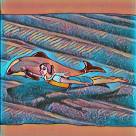
The Consumer Print by SHOK-1 (click image for more information)
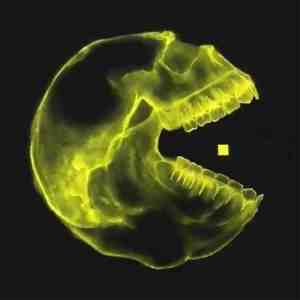
Pacman eats a power pill.
~~~~
Homo hubris:
Any human being who continues to embrace the Anthropocene as good; to dominate natural processes without cessation, to encourage all others to do so, and to be blind/deaf to any other ways of being, being foolish.
Homo ~ human, though etymology stems from MAN.
Hubris – excessive pride or self-confidence.
Mundus nemesis follows ~ it’s a correlating reflexivity:
Mundus ~ the world.
Nemesis ~ revenge. A downfall caused by an ‘inescapable’ agent.
The world seeks revenge in that natural processes responding to Homo hubris will create hell for Homo hubris AND all other species.
Newts, Pond, High Vinnalls, Mortimor Forest. Photo by me.
Today, it is me. But we are all connected.
I deal with love in my work everyday, it’s my legal and illegal tender, my blood-currency and reason for cellular being. I know about its multi-fractured complications. Fuck, it’s hard sometimes, especially when you feel you’re going under… again and again and again.
When there’s no silence, there is just noise.
Yesterday, I stood on the footbridge and watched two kingfishers pierce the heart of this noisy city. Yet I can’t find the peace, even in my wildest places or memories or rainforests. They are ON FIRE.
A volley of curve balls and healing (YES) leads to… cancer and surgery and radiotherapy and brachytherapy and chemotherapy…and lasting side effects, and no energy, no work, no doctorate, no book. But left me understanding I have a second chance in life, and I AM SO GRATEFUL. So I return bursting with intent to bring that life-love to the big human world before it really takes me. To never give up. And people forget my work. Or ignore it. Or sideline it. Or replace it with others.
I want to help life through love. All life. Because it is SUFFERING and it’s going under… again and again and again. And I know what that feels like.
But here are the rebellions. And also the bitterness and the criticism. And I want to throw the love over it all like water over a wild fire.
But the shadows keep stretching from those flickering flames. And I keep learning from them ~ I do. And then new things happen, again and again and again. And I’m fearful of a recurrence ~ therapy grants me acceptance of the fear – though
just
does
not
dispel
it.
And beneath all the smiles, I don’t recognise my post-cancer self in the mirror. My mirror has rusted up. And the love of my life, this man who gave me most hope~ my mirror (his word) ~ and our Earth song, has withdrawn to work towards something I genuinely no longer understand. His fears and the distance is killing me. And the loss. And I feel utterly alone.
I am fixed in the HUNT for the light I KNOW is already here. And I’m hollowed out. Bring ME that cavignus light, that I once gave away so freely, to dance in my own void.
And I am insignificant. And privileged. And RIGHT NOW the life systems, the processes pick up the slack in the best way they can, with all their mighty love, even with hell unleashed upon them by all of us. And the traumas of my own life merge with the trauma of life itself in our one beautiful, fragile, burning biosphere. It IS bewildering, and the breaths become shallow.
And I reach out for that hand. And no-one is there. So I hug my daughter, tight (she needs me). Withdraw from my sense of self, post cancer, post-mirror, in volunteering to help others. The love and the meaning, remember. Put the pain in a ball under your arm, and keep going. So I do. And I am not finished.
There is no real success (I don’t even know what that means anymore). Just the journey. And my beautiful, fragile, light-borne daughter.
The statement is astonishing in three ways. The Lancet’s editorial team must be accepting of XR’s peaceful, though criminally disruptive actions, as legitimate. In turn, they confirm the world’s governments are indeed criminal in their failure to tackle the planetary crisis. Lastly, they openly encourage all health workers towards direct action.
More. In the detail of the text, Richard Horton as editor in chief, addresses another public scientific establishment, The Royal Society no less, and seemingly with some disdain.
“…the Royal Society’s actions are empty of passion, devoid of campaigning, and seemingly disengaged from politics.”
The Royal Society, also the seat of the UK’s national Academy of Sciences, was founded in the 1600s as a select establishment of natural philosophers and academics. They communed in developing the scientific method, but eventually earned Royal Charter by Charles II, and were accepted as influencers, as such, by the State. As in science, minded towards caution until general consensus is reached, The Royal Society has always been a conservative organisation, acting mainly as arbiter between differing scientific views and members. Today, it continues to promote its members to the outside world, though funded largely by the Department for Business and Innovation.
Make of that what you will.
Einstein said, “Imagination is more important than knowledge. For knowledge is limited to all we now know and understand, while imagination embraces the entire world, and all there ever will be to know and understand.”
Science in Britain has instead largely become a fully-owned subsidiary of Economic Growth Inc, with most if not all university funding bids dependent on the ability to prove commercial opportunity or at least a contribution to GDP. Couple this with Universities openly courting the patronage of corporations, and the whole process of ‘science’ seems a bit of a profit-seeking stitch-up. This isn’t new, I realise, but science is certainly more cost-dependent as the price of new lab equipment and precision machinery has rocketed, along with the necessary information technology.
As if this wasn’t enough of a deterrent to upset any (expensive) apple carts, modern science and scientists deliberately distance themselves from emotions for the sake of warding off cognitive bias in their work. Fair enough, in so far as the work is concerned. But in cultivating the ethic, they have cut away something fundamental about being human, at least in public!
Some scientists are beginning to question the narrow version of their study, and are indeed calling for both an injection of imagination and a humility towards indigenous understanding. The very essence of an opposing conservative scientific outlook threatens the radical change required if our recognisable biosphere is not to be lost in a hurry.
Can the establishment ever turn the tide? Horton rightly calls the Royal Society out. But there are other institutions of critical importance to question. At what point, for instance, will the Judiciary itself turn at least a shade of green?
Priti Patel is (unbelievably) Secretary of State at the Home Office right now. This is the woman that wants to bring a steel fist to the prison system and with a strong whiff of retribution about her, it has to be said. As far as Extinction Rebellion is concerned, I fully expect she has briefed the Metropolitan Police to be steely in hand with protestors, no matter their race, age or disability.
I volunteer for an independent body working in the courts to help witnesses through the traumatic experience of trial days. I cannot attend Extinction Rebellion because, if arrested and convicted, I would not be able to help others who come to court, and who are often in desperate need for additional referrals. It bugs me, though.
In my research, I’ve found that there has been a sharp up-tick in violent crimes, domestic abuse and sexual violence over the last few years. And there’s a correlation with heat-stress. Even the Telegraph has reported this. These are the types of cases that eventually come before the jury-based Crown Court. The Metropolitan Police themselves released reports showing the link between rising temperatures and violence. Some irony, eh.
The violence is discriminatory too, in that mixed race women as a percentage of each ethnicity, are at a much greater risk (see Point 3). Here is a direct connection between climate change and racial/gender inequality. It’s just not fair, and the justice system should respond!
The irony is the Justice System (including Police & CPS), might involve itself in the fight for climate and ecological justice save for self-prosecution. But it’s going to be stretched beyond comprehension, struggling to keep up with cases; already short of funds. New prisons? At what cost, ecologically, socially and financially?
THIS IS HARD. Some of us know just how daunting the prospect of a collapsing biosphere and social existence might feel. But if the truth is not confronted, at least, by the ones who deal in truth everyday, who sit in judgment and bring prosecutions, then we risk any semblance of natural justice into the future, and ALL life as we know it.
I read deep sadness into those who will not confront truth, and who reject anything that does not conform to a narrow vision of what is ‘right’ and what is not. Methods of informing those in political power, and the greater population, have largely failed. Government and mass media maintain a tight grip on the very same economic system (and feeder-education geared for qualification and competition), which drives planetary destruction, whilst of course still generating wealth for the few and not the many.
The hard truth is human anthropogenic climate and ecological crises are also matters of racial prejudice, inequity and physical/mental/spiritual vulnerability, as well as harsh chauvinism towards all other forms of life.
A crunch point is coming. It may have already begun. But a compassionate response by all is the best response.
The critical work of institutions of establishment is no longer self-validation of existence or hiding behind neoclassical facades and traditions. Now is the time for these edifices to awake to a genuine moral calling, roll up their sleeves, and get stuck into real and profound social change.
Whether we are sleep walking, unknowing, paralysed by fear or strapped-in by some weird nihilistic procrastination, humans are edging towards a great drying and a great drowning.
And we’re taking so many innocent species with us.
The vulnerable and disenfranchised, human and non-human, will always feel it worse. Ecologism must be outed, plain for ALL to see, and the establishment institutions and journals must now follow the Lancet and truly engage.
After the age of 7, I admit to never feeling comfortable with teenage boys. I avoided them, especially at night. Today, in my imagination, I was 12 years old again, in an old homework room at boarding school. Hot tears were running down my face from painful homesickness for my Mum and the wild I missed, whilst hugging a 14 year old boy from a care home, himself lovesick for a loving family he never truly had.
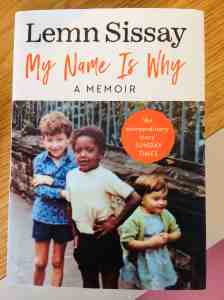
Lemn Sissay’s fearless memoir My Name is Why is a book of love by its absence. Lemn is the name given to him by his birth mother from Ethiopia, and means Why in the language of Amharic. Read the book for why she left him in a mill town in Lancashire, but it wasn’t intended to be forever.
An English name was super-imposed over his identity; Norman, Man of the North ~ and his blood ties to the south were soon smothered. He grew up like a coral tree through the hardest floors and walls of the places of a State trying to box him in. The Baby home, the Foster home, the Care homes, an ‘Assessment Centre’ which was really a cover for a borstal without trial. He reveals all in brutal evidence, printing the original letters and reports into the pages of his book ~ click click clack goes the typewriter ~ the documents slotted into four files were eventually surrendered to him years later in middle age.
Placed at just a few weeks old with a white religious foster family with their own unsoluble pain and enmity, this beautiful black child was expected to grow into a good Christian white boy. They collaborated with The Authority, as he describes those working for the State, to stop him from returning to the arms of his mother as she had wished. Not only was he separated from her, but from her culture and his roots. The foster family went on to have three children of their ‘own’, and the stresses of that would begin to tell in intolerance and un-lovingness. Just when he was entering a most vulnerable emotional time ~ puberty ~ they ejected him totally from their lives.
He was 12. That renunciation. The kick in the stomach. It would make anyone question whether love was ever real.
When I was 12, I was sent away to a boarding school, entrusted to Catholic Nuns by my parents to care for me, and they made me an emotional wreck. I began pulling my hair out with anxiety (now called Trichotillomania) and it is only since chemo last year that I have stopped.
I have not written about this before, and shared with only a very few people I know, but I’d been attacked five years earlier by a teenage boy when staying with relativesas my mother was sent away to a mental hospital to recover from a deep depression. I told no-one. As I read of Lemn’s teenage resistance to the callousness of his so-called carers, and the emotional turmoil they caused him, and the twisting of truth to fit a heinous racist steriotype, I think my imaginative hug was a yearning to feel that immense Lemn-strength, and at the same time quell my own rage. I was supposed to be cared for too. Care means the opposite of abuse. I wanted Lemn to feel the love he should have always felt.
It must have been traumatic for him, and also crystalised within me, like the salts formed from an evaporation. An evaporation of what we deem ‘secure’; what we deem ‘love’. I loved my Mum and she loved me, but she left me three times; to go away to hospital, to leave me in boarding school, and to commit suicide. Each time wasn’t her fault but I am scarred. Lemn survived the next few years by an incredible depth of resolve, knowing instinctively that things were just wrong.On each page of the book, he shares his hopes, and we witness them smashed, and then he rebuilds them again with enigmatic barefoot rebellion, night time wanderings, Bob Marley, and an explicit trust in poetry. He had been searching for love and freedom, and found more than the sum of both within himself. He escaped to a life of passionate devotionto the written and spoken word. And the story has not ended.
I feel the Unity of Opposites have been at play once more, in the tension between what is love and what isn’t, and the point along that plane inbetween, where justice lies or does not. We all need love in full-blooded fury ~ healing love ~ and Lemn did not get it.
Love exists in changling forms, from eros to agape and especially in storge, the parent/child love that may also exist between those not blood related. Imagination is a part of love. We experience in the ‘now,’ yes, but we remember the past and imagine the future. We formulate how we express love both in private and in public.
Lemn’s book is of private and public love unsentimentally described by its absence in the past and search into the future. This is a wisdom harshly earned and generously shared. We all want a better world and My Name is Why is as loving as a book can ever be. I hope he has received true love since, and tenfold.
It’s Autumnal Equinox in the Northern hemisphere, a point where night and day bridge equivalence like giant balancing scales. There is no opposition. All is flow throughout our annual voyage around the Sun. Yet light and dark are opposites.
Time flows constantly like a river, woven through life and death, change and recurrence: The sequence of days, the cycle of months, the rhythm of seasons ~ years pass.
The unity of these opposites provide the tensions needed in nature for existence. Tension, in this sense, isn’t necessarily about identity or conflict. It is more like the taught string of the musical instrument called life process, to be played with exquisite results. Where the notes are in harmony we may find justice. Where they are not, then our place along the plane of tension is unjust.
One could take it further and express all things this way. Life itself, for example, flows from the tension between existence and non-existence.
It’s been a while since I have mentioned the wisdom of Heraclitus. Equinox seems a good day to revisit him, as his theory of a Unity of Opposites still serves us well. Born to an aristocratic family in the ancient Ionian city of Ephesus, Heraclitus came to dislike power and religious conformity; and abandoned fellow humans to spend time wandering mountains and rivers foraging for wild herbs. I’d say he seemed Thoreau-like, but Thoreau was most certainly Heraclitean. Both must have felt sanguimund in some order, and with great philosophical influence.
‘Upon those who step into the same rivers different and different waters flow.’
Heraclitus’s famous river fragment flowed, I contend, directly from the River Cayster, “Little Meander,” which rises from Mount Ida and flows westward through Homeric Trojan battle fields into the Aegean near Selçuk, now Turkey. It once traveled right into the Port of Ephesus but the coastal zone has advanced and the ruins of Ephesus now lie miles inland. The city grew up and through the DNA of earlier Indo-European settlements ~ the Anatolians and the Hittites buried deep beneath with the ghost-language that is the root of much of our own. One only needs to imagine Heraclitus as a small boy of this city; a bright and inquisitive child, finding relics in soils and hearing hand-me-down tales of Eastern promise, or cultures assimilated or subsumed by Ionians, and then by the great first Persian Empire.
I also imagine the human landscape and floloca there, in tension, over space/time, tipping one way or another along that plane or string. The Cayster River silted at its mouth and out into the ocean, most likely due to agricultural practices upstream, eventually rendering Ephesus a distant memory. The river is ever dying and reborn; it preserves the form of ‘river’, one specific to its history, current existence, failure and future.
Within nature, we too are the same. In knowing, in closeness, what we can search for is justice and when we find it, hold on to it ~ the harmony.
Heraclitus must have known the Cayster very well, which is perhaps why the river fragment exists at all. The river was also key in Homer’s stories of the Trojan War, as backdrop to infamous battles scenes. The two men related to this river rather differently, yet it is the same river. The identity of ‘river’ remains in tact ~ it is known, familiar and remembered. But its structure and context is in constant flux. And this is the dialectic ~ The Unity of Opposites.
As is the state of life itself right now, and as in love, we must change along the plane of tension to find that point of justice. It’s a natural justice ~ we’ll know it when we find it.
It’s enough to realise just how much money oil companies globally have made over this last couple of years, leave alone centuries, and have, generally, not equitably distributed it.
First, they facilitated climate change by producing and marketing the fossil fuels that were burned by industry, transport and buildings to release green house gases. Then they discovered the global damage and ongoing crises they were creating, and covered it up. Then they continued lobbying for species damaging drilling rights, subsidies stolen from the poor, and anti-competitive price rigging. Coups and wars have been instigated over oil.
But then there are other oil-based and oil-fuelled products developed such as pesticides, fertilizers, plastics, internal combustion engines (cars), roads and guns (yes, guns). The airline industry. Add in the forced migrations from land occupied, brutally destructive oil spills, tankers, more slicks, poisonings, explosions, and the backhanders, and in the corruptions of the arms trade.
Second, the catastrophic effects of green house gases and climate change on all life and the ecological impacts on climate via the billions of gallons of pesticides sprayed. And the harm, and the suffering of all life.
And the funding of politicians who legislate, the universities who kowtow for funds, the construction firms that build the border walls that plough funds back to those who levy the cost of visas against those living in protectorates who are fleeing from the devastation caused by… you guessed it, climate change.










 After the age of 7, I admit to never feeling comfortable with teenage boys. I avoided them, especially at night. Today, in my
 It’s enough to realise just how much money
  Seasonalight
You must be logged in to post a comment.