The Anthropocentric mode of being. Norm of the Anthropocene. A problem.
Anthropo, of the human. Mode from modus “measure, extent, quantity; proper measure, rhythm, song; a way, manner, fashion, style” (in Late Latin also “mood” in grammar and logic), from PIE root *med- “take appropriate measures.”
Business-as-usual.
Tethering any potential vitanance of ecosystems to an ill-ecological disunion or dominion of human behaviour ~ mistake.
Economies, law and other human modes of existence are not fully diverse, inclusive and based on ecologism.
Is it possible to forge a new kind of relationship with the ecological community we in English call, perhaps, unceremoniously, peat bog?
Here in cool Britannic islands, peat has been forming since the last Ice Age, when luminous green mosses took over the quagmire. Fibrous layers of arrested entropy are fuelled by the surfacing of a froth of bryophytes, metabolizing through an exchange of oxygen with carbon dioxide, sunshine for sugar, nutrients, bacteria, and plenty of water. As each generation and their symbiotic partners die down, the decay is slow but sure in locking in carbon. Like snow transforms to glaciers, the dead are pressed down by the weight of the living into an airless solidity. If locked under rocks for millions of years, this is the stuff of crude oil.
At a tender accumulation of just 1mm per year, the process is slower than slow. In the slow period of human evolution, cutting peat to burn and grow food seemed just a nibble around the edges. But now, in full Anthropomode, the extraction is leviathan; industrialized, packaged, and shipped in plastic wraps to a peak of ignorance.
Peat bogs, high and low across continents, are keystone ecosystems in the slowing of the flow of planetary carbon. The absorptions are remarkable, storing more than all other vegetation communities in the world, combined (IUCN). At 6% of the total anthropogenic greenhouse gas emissions into the atmosphere, their degradation has a profound effect on warming.
As with all living systems classified in English, the words “peat” and “bog” together seem somewhat inadequate in describing the exquisite symbiosis and delicate processes of interconnectedness in these places ~ the kind of life-love I call Fluminism. These processes, in the name of a tiny minority of humans earning a living, are now being destroyed like there’s no tomorrow; cut, ploughed, burned, dried, stolen, degraded, and eroded. The critical second law of thermodynamics in living systems, otherwise known as entropy, is unleashed. A steadier state of life-creating disequilibrium (Margulis/Lovelock) becomes a gaping hole of profound loss.
Sphagnum Moss. Photo by me.
If ever there was a time when we ought to value natural processes capable of locking millions of tons of carbon into the ground, it’s now.
The invaluable emerald and gold communities of mossy production, which required such a delicate intersection of topographic, geochemical, climatic, and biological variabilities to begin, are vanishing.
An increase in entropy accounts for the irreversibility of such natural processes, an asymmetry in states from past to future ~ and in some cases the changes are irreversible. Even the hoof-fall of a flock of sheep can sear through a peat bog, triggering expanding evaporation of moisture that will degrade this ancient semi-closed system.
Globally, human cultures have aligned these atmospheric places of slow carbon burial with ghostly mythologies, perhaps a subconscious, spiritual warning to keep our ancestors from ruining these critical ecosystems. They are deemed eerie, often misty by the nature of transpiration of wetlands as if belonging only to lost souls and fuzzy apparitions.
Partly responsible are the will-o’-the-wisps or the ignis fatuus (giddy flames), documented and told in stories by many different human cultures around the globe. The Welsh, for instance, traditionally described the light as Fairy Fire held in the hands of mischievous goblin-fairies or nature sprites (think of William Shakespeare’s Puck) named Pwca*, who would mesmerize and lure travellers off their paths, only to extinguish the flames and leave folk abandoned and utterly lost.
We modern folk of the Westernish have forsaken such myths in favour of science and concluded the oxidation of phosphine, diphosphine and methane can cause photon emissions that can also ignite on contact with oxygen in the air. If there are bubbles of methane about, these too can ignite, and all the myths and hocus pocus are burned up into the atmosphere along with reverence and fear.
I cannot seriously suggest that conjuring a new state of fear for the precious and vibrant matter (Jane Bennett) of peat bogs will save them. But maybe love, reverence and celebration could.
When all the most technical minds are searching for ways of trapping carbon from the atmosphere, it seems utterly foolish to ignore the sphagnum mosses and their partners as a true commonwealth in the slowing, dampening, and sequestration of dangerous climate change. Maybe we can begin by joining together to form a Union of Concerned Peat Bog Lovers, or The Great Sphagnum Mossites, the Emerald and Golds, or simply The Pwca Tribe, to write and tell stories about the magnificence of the processes involved, to create an annual Festival of learning near each place, and to take time to join in reverence, celebration and protection.
Suggestions welcome, as always.
*It is thought Shakespeare may have learned of local Welsh folklore from a friend Richard Price of the priory of Brecon. Could Cwm Pwca and the beautiful Clydach Gorge be the original setting for Midsummer’s Night’s Dream?
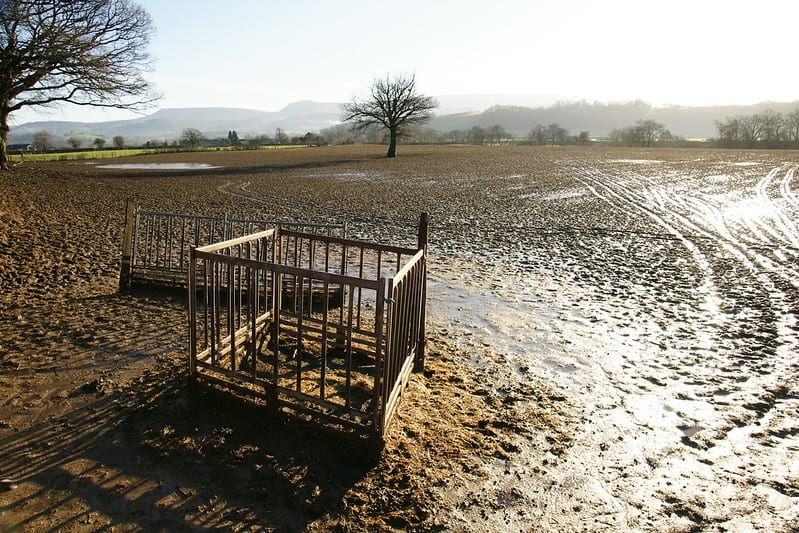
Sheep field next to the River Wye, nr Hay. Photo by me.
There seems a renewed and furious human chauvinism by some, rejecting the material reality of ecological processes to the extreme, including the principle of Rewilding (Soule, et al).
The fury seems based on NGO dominance in the field (they are certainly not democracies), plus purchasing power without local consent or participation. NGO’s aside, because alternative treaties for collective and local management are possible, without ecological succession we are talking about the proliferation of anthropogenic urbanization, suburban expansion, farming, fishing, and forestry as the default position on a central plank of Human Rights.
In reaction, particularly to the question of urbanization and suburban expansion, the legally trained and culturally-influenced capitalists (though they would deny the latter), are persisting in claiming the Rights for Nature. All arguments are, therefore, sucked into the realm of the Courts, to mainly White Eurocentric judges, lawyers, and clerks. Rights are important agreements of equality between ourselves as human individuals, there is no doubt, and they are judged in Courts by other humans versed in the language of humans and the Law. All of these Human Rights should be firmly based upon ecological and physical material reality because that is the ultimate responsibility. But let us not forget that ecological processes are incommensurable with complex Laws evolved for one, single species ~ Homo sapien. One could call the Courts an “artifice” in ecological terms.
Terribly oversimplified, there are three main interconnected effects that drive suffering and extinction of human and teresapien life.
a. Global human inequity (to include extreme capitalism, arms trade, neo-colonialism, GDP Growth, racism and poverty, nationalism, conflict and migration, et al)
b. Ecological depauperation and biodiversity declines (critical to existence)
c. Climate crisis (volatile, extreme, and includes sea level rises)
Inequity has a great deal to do with depauperation and climate, but without ecological resilience, quite frankly, we (all life) face armageddon. Food and clean water depend mainly upon b. And c. contributes to a. and b.
We are, indeed, nature. But we are not the sum of all ecological processes. We must understand moments when letting things go is as important as when, where, and how to intervene. In not allowing succession and a plethora of other life-sustaining processes–some of which we have no idea–to re-instate their own evolutionary force, we are continually arresting ecological growth, interfering with ecological cycles of entropy, and preventing niche opportunities for life to flourish. Disturbance can drive evolution over time, but planetary dominion by our species has all the features of a catastrophic, continued extinction event (pain and suffering). As Chomsky said, “we are the asteroid,” more accurately, the conscious asteroid.
Ecological processes are core to ‘life.’ Indigenous cultures greatly understand this, and we in the Westernish have a full opportunity to learn from these people and their wisdom. I agree, that without consent or agreement, all interventions, passive or active, are forms of oppression. But the most oppressed of all, we have to remember, don’t speak human.
Ecological disturbance (that’s what we are, ecological disturbers, primary and secondary consumers), is now so vast as to arrest and even undermine evolutionary succession across all biomes. Climate change is fundamentally linked by the nature of this dominion, especially in the destruction of ecosystems for the extraction and burning of fossil fuels.
There must be room for ecological succession without heavy human disturbance. Setting up Rewilding v Traditional Pastoral is a non-starter. There’s no pulling the past out of a bottle like a genie, but we can learn from all, science and indigenous wisdom, moving forwards.
What if.
What if it’s not the last 50 years of human interventions that have caused the crash in living systems here in the UK, but the last 200 years? What if it’s not the last 200 years of human intervention but the last 10,000 years? These are still relevant questions in ongoing geological discussions as to when the Anthropocene began. They are also relevant to how we perceive a need for change.
Without the development of farming techniques over the last 10,000 years, there could not have been an industrial revolution in the last 200+ years. Without the industrial revolution in the last 200+ years, there could not have been intensive development and farming over the last 50 years.
People are considering we must again, at least, adopt the traditions of, say, 50 or 200 years ago, but in many ways, these are assumptions based on an emotional but often warped sense of comfort that stems from nostalgia. Human Rights? I have outlined before and above the problems of Rights, and believe in a fundamental Responsibility for all life in all we do. Ecologies have changed, the climate has changed/is changing. Our numbers have changed. And all kinds of social patterns have changed. We need to look at each place, case by case. We are in crisis.
Urban agriculture, urban ecology, community gardening, produce share is totally underestimated here in the UK. These are lands already heavily occupied by our species. To most people, rural land is utterly unavailable. To them, rural land may as well be the deep blue sea or the rocky mountains. Cities and suburbia offer, at least, a chance to form strong community bonds with a critical mass of political will in order to form gardens, homesteads, and varying organic horticultures: Reclamation of the public place. Why do we continue to allow ourselves to be dominated by landowners, NFU, supermarkets, NGOs, and/or corrupt state politics interested only in maintaining the status quo? Bring back food/ecology into local control, where the majority of people reside, including distribution, and let locacede happen where it can be agreed and will be welcome.
Above all, we are making choices now. Claiming successional processes, or re-introducing trophic species, are an “artifice” in favour of Homo sapien farming practices 50 or 200 years old is a broken concept, because all we do about living within resilient ecologies from now on could, therefore, be classed “artifice.” Remember, and for Earth’s sake, the real “artifice” is pouring tons of chemicals onto the land, draining rivers and water tables, forcing seasonality, and being exclusive about who manages the land, whether it be farmers, rewilders, developers, or industrial biochemical and genetics companies. We can do better and for all life.
Would it make any difference if we knew our ancestors could see what we are doing to Earth now? I look at the newest cosmological theory of time. Indigenous thinking may be closer to the truth than we in the Westernish may ever have considered. Until now.
On the basis that the Anthropocene is a planetary extinction event, there is no good Anthropocene. The Anthropocene covers only a small part of the full experience of Homo sapiens, indeed the family Homo.
Could we ever consider earlier periods of the human experience more progressive? Huge energy resources are expended and ecosystems killed for the extreme Capitalists’ yearning to sell that so-called progressive future. For instance, Elon Musk’s private, personal vision for a Mars mission for profit may not be in the full interest of the entire Planet Earth, especially when all is skewed by the idea of making money. The idea of space exploration may be inevitable for our inquisitive species, at some point in time. But surely there should be a union of everyone in any efforts beyond our atmosphere for everyone, and every life form, launched from a secure home planet.
Sanctuary Earth a given, other than the two main strands of human wellbeing of health and good relationships always a necessity for our species, we already have the technology to produce food, clothing, and shelter in a nature-aligned way here on Earth; an expression of fluminism. All the rest, right now, equates to profit for the few and a dying planet.
That we in the modern Westernish consider future time as instantly progressive is also a failing. The English language determines a structural perception of time that is different from others and, as it becomes globally dominant, so does the perception of time. We think of time as linear, the past to our left, the future to our right. This is how we write, from left to right, and how I am creating typed words on a screen right now. Einstein’s work on time contended that it’s the fourth dimension, relative to all else via gravity, including how fast we move through space. Perhaps we should write in whirlpool patterns, to reflect the past, present, and future. Consensus continues to build on so much of Einstein’s remarkable insights on relativity.
Rovelli goes further, and this is where it gets super-interesting to me. In his work on loop quantum gravity theory, time is a non-entity. There are simply events that are related in all directions shaped by gravity. Our neurobiology creates memories in order to survive the impacts of the complexity of almost infinite frames, reflected in how we create film so that we can record and replay. Imagine all the different perceptions of time as a force by all the lifeforms that have ever lived. There may well be beings who perceive more or less of these saved copies in the ether. Such ideas are as mind-bending as Galileo’s assertion that it is actually the Sun that revolves around the Earth and not the other way around. *
My imagination is running free, and moving from one event to another in the quantum world seems somehow possible, if only we could find a way. Rovelli’s work doesn’t imply universal determination, because the geochemical and physical variables are different from moment to moment, and living beings are constantly making choices. Each wave placed into the cradle of what we call time represents a different universal set of atomic experiences as we spin through space. Who knows whether those experiences might have evolved very differently in life on Earth if we had been more proximate to black holes. If there is other life in the vastness of the universe, the basic perception of experience itself may well be entirely different to our own, and so too ideas of communication. Perhaps, we are already surrounded by messages, and we just don’t have a clue.
The real nature of time is yet to be fully decoded, though our perceptions of it have huge implications for the way we live our lives, expectations upon future generations, and the way we relate to, and as part of, nature. How do we frame the context of the Anthropocene? Did the Anthropocene begin after the last Ice Age and the transition from hunter-gathering to nomadic shepherding, and then to sedate farming practice? Or the Industrial Revolution and Capitalist/White Eurocentric Colonialism? Nuclear detonations? The geologists continue to argue the implications of all these events in the rock record. Perhaps, Rovelli’s work gives us leeway to accept the past is not something so distant, and could well be more progressive in certain ways than any vision of the future. Regardless, the decisions we make today do not have to prove themselves to be anything other than caring.
In the Westernish, clocks dominate, and time is money; there is an anxiety about time as a resource; death is time-up unless one believes it is eternally enjoyed in the spiritual afterlife. We know, for sure, we have at least one life. What if the afterlife is in fact our ancestors held inside the cradle of time, and if we are close (the physical nature of this still to be determined) perhaps in certain gravitational fields, or in places which are close, we have subatomic feelings of these past realms. Perhaps, the Everywhen, or the Altjira, or the just plain Good ( The Dreaming, named by anthropologists) of the Australian original peoples are closer to the truth than Relativism could have ever conceived.
Back to the present, this precious phenomenology right now, one of the remaining species in the order of the Great Apes, Homo sapien, is risking all life ~ ALL LIFE ~ therefore, global evolutionary forces too, for their own purpose. Unlike the previous five known major extinction events caused by random geological and cosmological forces, recorded in time’s cradle somewhere nearby, the Sixth is fully conscious. If we can feel those lives suffering maybe they feel us. We are a conscious asteroid.
Ocean waves containing trillions of viruses, photo by me.
Life is never split away to nothingness. Even as prey, we are consumed by others. An ecological death is the breath of others. Sex is a consuming, an appetite. The cell itself is the most exquisite sex, a moment of evolutionary consumption. A very long time ago, one bacteria consumed another and the other survived too. * Both replicated in the union. This is the cell in perfect symbiosis.
Lynn Margulis, the great biologist and theorist, not only found proof of the process but fathomed a true power in it. From these two fused micro-organisms, and on through time, the reality of all life processes is in this direction ~ together, even after death.
Here, in the middle of a brutal pandemic, where Covid19 still evades extinction, I’m also going to tell you that viruses count, and in similar ways.
Viruses are not supposed to be alive, yet their enormous genetic volume swarms through our nagorasphere as if they are one the most intrinsic families of life. They are abundant everywhere there is life. They are even found in the giant sub-seafloor microbiome surviving for thousands of years. They are genetic parasites, though do not always destroy their biological host. They break into living cells to replicate their genetic patterns, and burst out in a process called lysis, which may end the life of the living cell, but not always. They can transfer genes horizontally from species to species, triggering speciation and leaving their ‘marks’ in surviving DNA. 8% of our own genome is laced with the remnants of viral genomes. They shape life by stimulating immune responses, and even by causing death.
In these many epochs of the living Earth, the flow of metabolism, and togetherness, and consuming, and sex, have remained unbroken for billions of years. Even after global cataclysms, life prevails. It seems unstoppable. Viruses are all part of the flow, like the dark matter of the universe. They are critical ecological agents and possibly have been managing populations of bacteria since way back before the endosymbiosis of the cell.
I have explained before that it’s probable that Covid19 had been bubbling away in mutualistic symbioses among bat, other mammalian, and even human populations of the forest valleys of Wuhan for some time. That our technologies like air travel have pushed it around the world has proven it to be devastating to novel populations. New viruses naturally take generations for our immune systems to de-code. Highly lethal pathogens are, of course, a dead-end for the viruses themselves, killing their hosts before infecting others, or mutating to infect others, in different ways. Covid19 lies somewhere between a mild immune-stimulating event, able to infect many often before detection and any show of symptoms, and a deadly Category A event, for humans at least. Many other forms of viruses are harmless, or even beneficial.
Bacteria rule the world, and viruses rule bacteria. In humans, we are realising our virome can manage the populations of our gut biome in positive and negative ways. Anti-bacterial and anti-viral medications save lives, but we don’t know the full extent of the effects upon those critical symbiotic relationships. They leave their trace, like messages through genetic time.
Most startling of all, and completely mind-blowing to me, the oceanic virome could be so powerful as to be critical to governing our climate. Bacteria and cyanobacteria are the ocean’s recyclers of nutrients and alter chemicals and gases we eat and breathe. A viral infection is the breath of others. As viruses control not only the numbers and densities of bacteria, they also change behaviours. Who knows how far up the trophic levels these effects travel. Despite our curiosity, we still know so little about those enormous systemic effects, including climate.
Could we ever learn to love viruses? Maybe not. But they are revealing themselves to be as ancient as life; genetic sculptors we symlings could never do without. Just like the origin of the cell itself, bacteria and viruses come together, swap DNA, and leave tiny comet tails of potential throughout all life. I’m sure we will continue to learn more about them, despite deadly pandemics, and even to respect the enormity of their littleness.
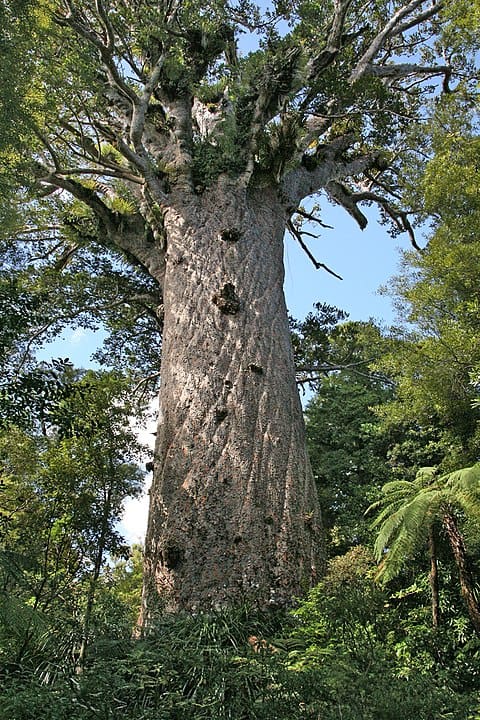
By W. Bulach – Own work, CC BY-SA 4.0, https://commons.wikimedia.org/w/index.php?curid=64587917 Photo – the mighty Kauri, one of the most efficient nitrogen process recyclers on Planet Earth. Click on the image for more information.
Fluminism brings together my thoughts over a number of years. I offer an alternative to Biocentrism (Taylor), Ecocentrism (Naess) and, importantly, Anthropocentrism (Passmore, et al).
To be a Fluminist is to recognise oneself viscerally as part of the interconnectedness between all beings ~ Symnexia (Sanguimund), and in this realisation, to act with love, respect and responsibility in protecting these interconnections, minimising the breaking of their flows, to find fluministic ways to proliferate and send new flows ~ Praximund.
The following is an extract from my dissertation, including narrative scholarship.
~~~
5.4 Praximund: Responsibility and the Sacred.
There are problems with the theory of Rights taking precedence over Responsibilities. Many indigenous people understand this. Rights are merely human constructs, legislatively fixed (when processes are not), but politically vulnerable and impressionable by further human culture/population dominion.
Natural processes and fluministic interconnections have evolved, are evolving. There exists intrinsic, self-willed, complex patterns across space and time. Free-willed, save for our excess. We participate, as part of nature, yes. But because of this excess of destructive behaviours, rivers, forests, mycelium and migration need more than ‘Rights’ afforded only by humans, and a minority of humans at that… for this too is dominion.
So I have a name for the responsibilities and an adherence expected. A unity of opposites ~ a natural law, but not a law. I call it Praximund (latin; process/Earth) the deepest possible respect for natural processes, and a fundamental requisite of fluministic action. Infringe only with negative consequences to oneself and all life, the biosphere, as we are all interconnected. There is honour and pride in celebration and ritual of it.
There’s credence in declaring ecological interconnections sacred as a route to the protection of life, a full sanctity of life (Kumar). Nurtured this way, perhaps, the sacred become inviolable. Constituent lives are liberated to evolve with a free-will, a flourish of nature’s effervescent, green fuse. More, by cultivating a collective reverence for the presence of a community of living beings ~ through narratives, ritual and rules ~ we may look and ‘see’ life in new ways, a wave of sanguimund spreading though each one of us, the wonder of interconnected life. There have been many before us using sacred words with similar meanings now lost, and I hope many after, with words yet to be created. All I ask that we think about creating our own sacred in and with the natural world (Milton, Bateson), building narratives and exercising rituals in what is of utmost meaning to ourselves and together. Then, defend from the profane. And that defense, in sanctity and in love, will need to be strong.
Narrative Scholarship.
Guarding the sacred is not limited to protection from human intrusion. Sometimes, the opposite is vital. Sometimes, the sacred is one’s presence or consciousness and the tending of ecosystem in a loving, fluministic way. Fenced-off zones around Chernobyl have led to non-human life returning in abundance. There is a sanctity in the absolute devotion of ecological networks of that place. But the absence of humans is not a pre-requisite of the sacred.
Churches may seem at their most holy when the bells toll loudly, when the stalls are heaving with parishioners singing hymns at the top of their voices. The sacred seems to exist somewhere in the union of the people in the nave, all facing east, a sense of reverence helped along by those clever architects placing windows in the clerestory to remind of God’s presence in beams of moted dust light.
The land can hold us with a similar sense of direction, commitment and devotion. And God need not be involved, unless he is simply love. A private moment, no less, can be the touch of grace, with such strength that it can change one’s perspective forever.
I lean over my Grandmother’s grave and remember her strength. Fused into my memory cells, she’d garden with such force as to create her own weather system. This memory seems sacred, but not her grave. I feel the difference in remembering I am her kin.
It may not be a surprise the reader that I feel the sacred most in perceiving those bristling interconnections in the living world, the living, quietly seen or unseen. A humble field maple will do it, with birds in the gnarly branches and fungi at the roots. Their Autumnal yellow glow takes my breath way and I am minded to sit for hours and just be present. It is a profound love, intense and moving.
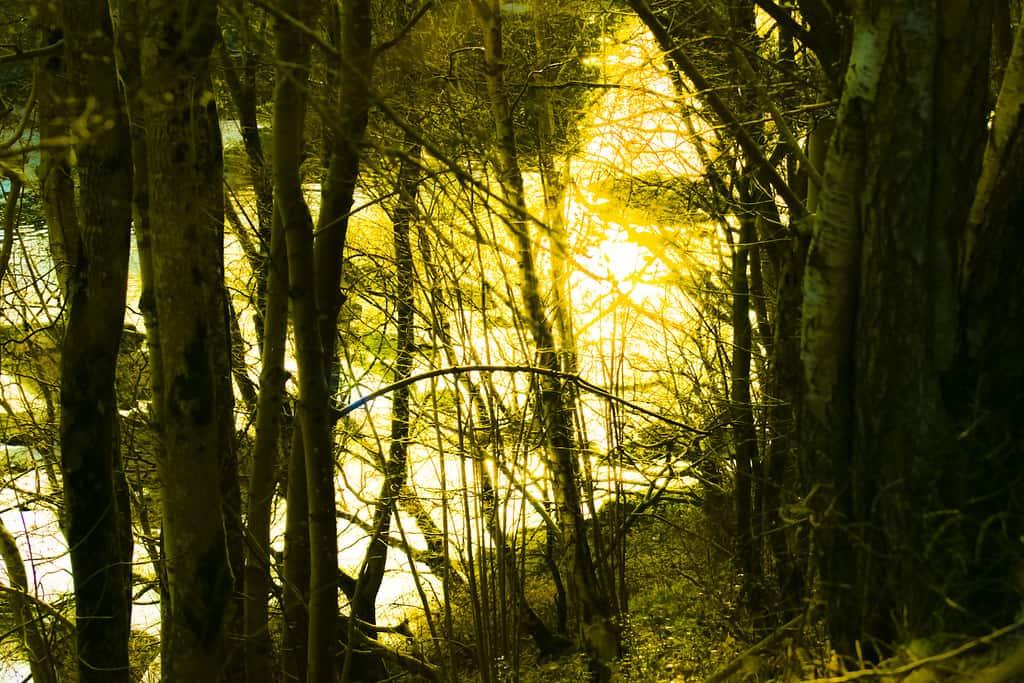
A mother fox licking her young, a tender petal opening to a bee, these are all things bright and beautiful. Light is important to me, I have been to the darkest of dark. That the direct or diffused sunlight gives succour to life seems profound. I love the light around waterfalls. So do the mosses and the liverworts.
There are also the green rays at sunset, or during eclipses, the last and first moments of light bent and scattered through our thin atmosphere like moments of magic.
Hokianga
The sacred can also be a memory, an event marked at a place only by the truth-myths passed down through generations. From the eastern sunrise, I once arrived at the spectacular Hokianga Harbour, North Island, New Zealand, an area brimming with sacred Māori sites. Yellow dunes on the far side of the bay shone brightly sucked back into a baby-blue vacuum. An incoming tide from the Tasman sea swept the bay clean with crested wave upon wave, and variable oystercatchers flew low at blistering speed (I could just make out their uncanny calls).
I followed a sign to a look-out point high above the harbour entrance and sat on a low wooden bench. I felt an immediate essence of something profound here. I was positioned somewhere on the edge of it all, and it felt like sanctuary.
Later, I walked along nearby Omapere wharf and talked to a Māori man from the village who was fishing with a simple line and hook. I was just a tourist, yet he was so generous in conversation.
He told me his Māori oral tradition, that legendary Polynesian explorer, Kupe, of the Matahourua canoe, made first Aotearoa landfall and lived here. The story goes that he named it Te Puna i te ao marama ~ the spring of the world of light ~ until in his old age he decided to return to his island birthplace, Hawai- ki. The words he spoke as he left were, Hei konei ra i te puna i te ao marama, ka hoki nei ahau, e kore ano e hokianga-nui mai ~ this the spring of the world of light, I shall not come back here again ~ and so, granted Hokianga its name.
The vessel of the sacred contains a good measure of vulnerability. Maybe this is an essential tension that drives us to protect.
Great sacrilege occurred at Hokianga, long after Kupe’s departure, against the endemic and the Māori. The mighty kauri trees, like the blue whales of the world’s forests, were wrenched from inland Waipoua and floated down the river for milling and global export, mainly by the hands of Pakeha (non-natives). Unlike the Māori, who would take chosen trees with a reverence, for canoe- building, the Pakeha took nearly all.
And without the kauri, large parts of the forest died and many endemic species lost forever. What was left was turned over to dairy, and again those products exported globally from the Harbour. To destroy the interconnections between living things is to destroy the most sacred ~ life.
Another Pakeha, William Roy McGregor, professor of Zoology, successfully campaigned to end logging of the Waipoua Forest in 1952 and created the Waipoua Forest Sanctuary. The sanctuary is still weak from attack, with Kauri Die-back disease laying claim to regenerating forest, and climate change will be having its effect. Let’s hope this small part of a once vast, ancient forest recovers to it’s truest dynamic state of being, given full protection and time.
Unlike the great Kupe, perhaps, I’ll return to Hokianga again one day. Modern technology makes it easier for me, though I’ll have to watch those emissions (always some kind of price to make such returns). The harbour and surrounds are a wealth of flora and fauna and, until then, it will be the distant sounds of the oystercatchers, torea-pango, that will remain in my memory as symbol of the sacredness of that place. If I am quiet enough, I can still hear the sacred, right now in my head.
~~~~~~~
The story also told here Te Ahukaramū Charles Royal, First peoples in Māori tradition – Kupe, Te Ara – the Encyclopedia of New Zealand.
~~~~~~~
For more on Māori reverence, customs, ritual and stories, including the mauri of the forest (the life-force) invested in objects and buried under important ecological places or tane trees, as acts of protection.
~~~~~~~
End note: Waipoua Forest was bought by the settler-colonialist Government from the local Te Roroa Māori in the 1870s for around £2000, no doubt putting them under immense pressure beforehand. Locals were disenfranchised from the receipts of logging, except to be employed in some of the most dangerous work. McGregor’s protected area was a legal entity under the Laws of the New Zealand Government, yet was suspended in the 1970’s for further logging. After yet another campaign, it was stopped. I wonder, if the practices of mauri “life-force” had been continued by all, and regularly, would this infringement have ever occurred?
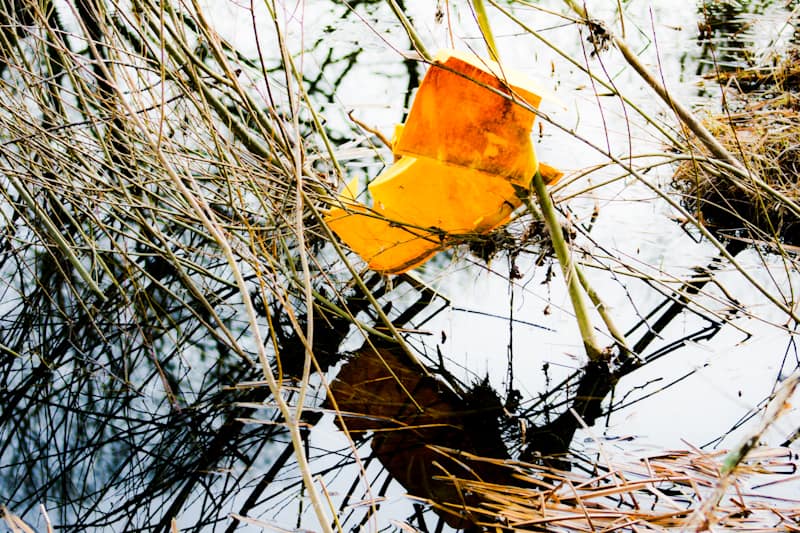
Plastic waste snagged during floods along the River Wye. Photo by me.
Unless you believe that we are members of some kind of intergalactic cult, we humans are not alien to this world. We are intrinsic to it; a manifestation of the diversity of all the life that ever existed.
Despite our geologically recent farming cultures, the schism between humans and the rest of nature is false. In fact, growing and harvesting food, generating our water and energy supplies, and getting rid of waste is where we are submerged deepest into the flows of life, and where we are perhaps closest to our teresapien kin. The problem is that the connections are now largely negative in the flow of ecological and climatic entropy, and in our moralities.
You can tell how Capitalism deconstructs the interconnections that sustain life. Just look at waste costed into price. It’s something we try not to think about, until it more obviously surfaces in the flood waters, or flaps from a road verge, or a school yard. The recycling industry, as it stands, is a Capitalist perpetuation of the problem.
More often than not, the invisible dangers are the deepest concern, the ones our sensory organs cannot easily discern. And these are delicate and complex dangers because life systems are both delicate and complex. We either need access to the tools to be able to trace these dangers, or see them manifest in ourselves, our loved ones, and in other life forms, in the shape of disease and death. Even more resources are required to then treat and save, though teresapien lives are not granted anywhere near the same attention as humans, and some humans are not granted anywhere near the same attention as ‘other’ humans.
We are always playing catch up with the negative forces of competitive Capitalism.
It’s beyond time to apply the Precautionary Principle to extreme Capitalism itself. Capitalism puts public (human and teresapien) health at risk. We (the biosphere) can no longer afford to let these harms be driven by competition for a fat bank account or a gilded mansion. I am not speaking of local trade and creativity, and I am not speaking of basic comforts. Some say it would be paralysing, to restrict a natural drive to accumulate resources in cash and property for further innovation. But there’s no paralysis more permanent than death. So what are the alternatives? Because these too are intrinsic to the Precautionary Principle. Let’s create them collaboratively, with no waste, and for the good of all life.
Climate scientists and activists are still tending to think and communicate to the masses in human socio-political terms, even going so far as to reject the worth of saving NGO-promo animals (trees, whales, pandas, polar bears), or other teresapiens in general as an un-emotive or meaningless exercise, and continuing to place the human species as central to all like a gravitational force.
To bring people into the Nawoken, may require the initial motivation of something much closer to themselves. What immediately touches us drives us. But tragically, that too is a legacy of white, ‘Enlightenment’ colonialist separation, reductionism, or bifurcation. Many of the indigenous communities, before the violence of European colonisation erupted, were already living vast eco-logical interconnected lives, honouring and respecting living beings and places, to include the inorganic, where humans were culturally not centre-placed in isolation in all decision making.
This is NOT to take away the human imperative. It is, instead, to add the imperative of allinterconnected life, upon which we are all a part, dependent, and having intrinsic value in and of itself. One shared biosphere.
Often, teresapiens were ‘personified’ (Wall-Kimmerer) to be included in all the most weighty decisions. Ancestors, descendents and “Country” (the floloca) similarly played essential roles in the hearts and minds of communities, no better described here, in short, in the proportionality of indigenous peoples of Australia (Graham, Brigg). In doing so, these peoples thrived whilst maintaining complex ecological flows within relative climatic stability across varying bioregions and languages, with equitable consumption patterns and little to no waste. Sometimes that meant leaving things alone as sacred, at least for a period of time, if not forever. In my own eco-political framework I call Cherishism, the Cherishers would make sure all had a ‘say’ too (teresapien lives evaluated with sincerity and reverence in all decisions).
Whatever we do in our seemingly irreversible technological imprint on Earth, these foundational ways of eco-logical living must now return, with ecological growth in both abundance and diversity of all that is now dying.
It is right to fight for human equality and equity between ourselves, for a basic human exchange of empathy, compassion and altruism, but also because those divides themselves continue to drive biospheric destruction and depauperation; air, land and oceans (Grey, et al).
But to survive in our one shared biosphere, more, to thrive as an honourable part of it, those of us in the Westernish, where our Long Covid-like Enlightenment period is still fueling division, bifurcation, hierachies, racism, and consumption-driven destruction in a globalised market, must truly analyse and synthesise our place within life systems, biologically/ecologically, and re-evaluate where we stand.
We are Symlings among symlings, in vast and complex flows. I now call the study of this way of life Symbioethics.
True wisdom would mean listening to our species elders, educating our loved ones, observing and attuning with living ‘flows’ (loves), along their lines/planes/three dimensional places ~ four dimensions, to count the ‘spiritual.’ We are part of nature, not alien to it, and our children and grandchildren deserve to reclaim that billion year old identity.
This superego-juddering shift, despite all the mechanistic political approaches, National/UN targets and agreements possible, is essential.
~~~~~
Look, my work on Fluminism proves, I contend, that climate justice is about saving all lives with equal devotion. There is NO divide between climate justice and ecological abundance.
We are all nature – we are one and the same. Concentrate on the processes that hinder flow & create suffering. #Fluminism is as much about resisting racism and poverty as it is about ecological growth.
Humans are not ecological producers. We don’t even photosynthesise! We ALSO don’t decompose organic material into elements for renewal. We need to look after the ones who do. We are part of system far bigger than us. The biosphere! But what is happening IS an extinction event.
If you don’t, then Homo hubris (the legacy of WhiteMAnthropocentrism), will continue to dominate – we are not central to all life. We are ecological consumers, dependent upon others, including bacteria within. We need those ‘producers’, and the beings who sustain them.
They help regulate climate, they keep life forces flowing on land, in the air and at sea. They have been punched and pulverised, bit by bit, continent by continent. It has to stop. And fairly, for humans and teresapiens alike. Which means capitalism is no answer. It’s unfair!
I understand that being victims of white oppression over centuries would mean easy rejection of Deep Ecology (ecocentrism), where the whole is put above the needs of the few (a form of utiltarianism). But Fluminism is alternative to holism. It looks to processes instead.
Processes that sustain life. ALL life (you, me, wherever, and every single living organism). Equally, equity, by the very nature of their dynamic, interconnected flows. #Symbioethics
Might you gather these wonderful tweets about ‘fluminism’ into a single-thread so we can refer to (& retweet) all these together? As @jimj220 used to say “equity equals survival.”
That’s kind, Aubrey. The short of it is, of course, love (love being a doing word) for all living beings – plant, animal (inc humammals (equally) ), insect, fungi, bacteria… even viruses to a hidden extent. #Fluminism



 Climate scientists and activists are still tending to think and communicate to the masses in human socio-political terms, even going so far as to reject the worth of saving NGO-promo animals (trees, whales, pandas, polar bears), or other teresapiens in general as an un-emotive or meaningless exercise, and continuing to place the human species as central to all like a gravitational force.
 Seasonalight
You must be logged in to post a comment.