I haven’t been to Bodenham Lake for a few years. Last time, I sat with my little girl in a bird hide on a cold wintry day, with Bendog at my knee, bewitched by barnacle geese feeding and preening. Today, Gracie started sixth form college, so I decided to mark it with a wilder walk on my own.
My intention was for a quiet moment of reflection. But, ah, to wander the old quarry lake worked hard by the Wildlife Trust for the benefit of gentle waders, with their stick-thin legs and crackable eggs. With internal combustion engines at full blast, and the other crushing, whiny sounds of bulldozers and chainsaws travelling loud across an expanse of flat, steely grey, there were no water birds to be seen. In fact, there were hardly any birds at all. So I headed south to the River Lugg.
And to an extraordinary encounter!
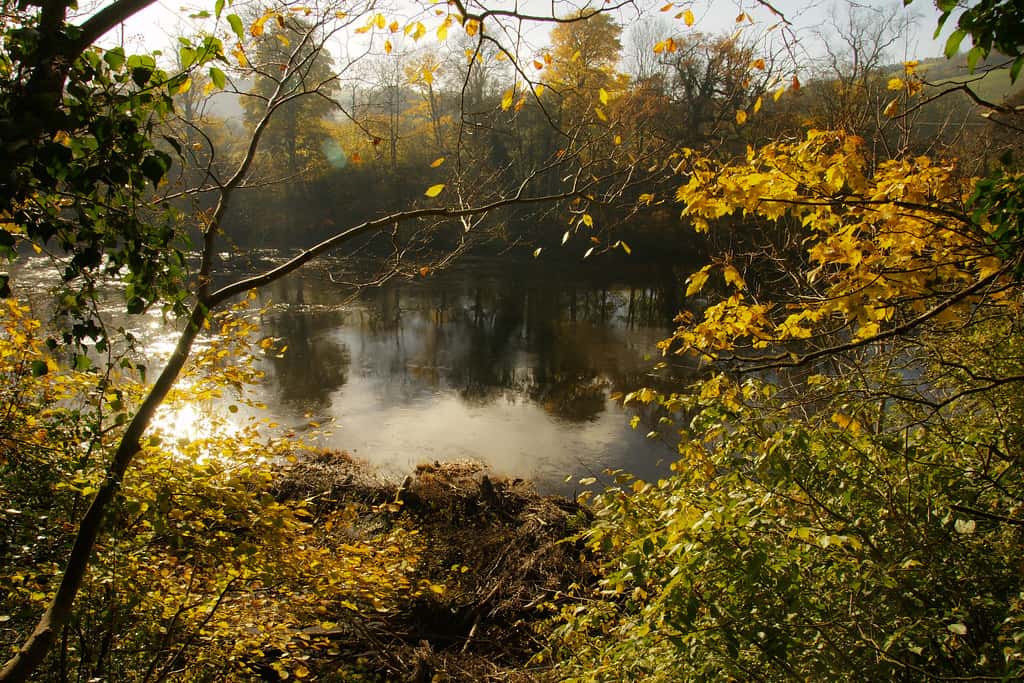
I walked through an open field squeezed between lake and river, pocked with a few lazy sheep. About halfway along the riverbank was gnarly, old Hawthorn, laden with Mistletoe. Her trunk had split open sending branches north, west, south and east, such was the weight of her hemiparasites (Herefordshire’s county flower). I stopped to point the camera and took a few shots, to continue on for about 10 metres.
From fiddling with my camera’s on-off switch, I lifted my eyes to find Goshawk coming at me full-speed, silent, like a thick and deadly arrow.
It was too late to duck, but there was no need. I felt the air displaced just above my head. This lethal beauty, wings tucked to his sides, speared onwards, swift into Mistletoe behind me. I heard a rustle of leaves, and spun around as fast as I could to see he’d struck his prey squarely against Hawthorn’s bark. A ball of ruffled feathers slipped slowly down into the undergrowth, and I lost sight. I heard a tweet, then nothing. Even the bulldozers and chainsaws hushed.
I waited for another sign. Those seconds passed ridiculously slowly, and my pulse throbbed in my neck.
Suddenly, Goshawk lifted up, his prey gripped tightly in his claws. He swooped from the bank to fly low, and westwards over the rushing water until way out of sight somewhere upstream.
The return to serenity was uncanny. I looked across to the other side of the field, and to the tree where Goshawk must have been spying with his sharp eyes and intellect – Tall Willow above the lake. From some distance, he’d spotted his target bird hiding from me in Mistletoe, and then watched me walking away. I had been triangulated, my speed of walk gauged to perfection. The little passerine ~ I have no idea which species ~ was distracted by me, and had scant chance to escape. I was Goshawk’s perfect cover, and at the exact moment required.
Not only had I been witness, but structural to this lethal and lightning hunt; a first for me in a life of wandering the wilds. So I’m compelled to share it.
And I won’t forget it anytime soon.
The scene, a few moments before. Goshawk struck from the left and took flight with his prey to the right.
Wye at Hereford – mute swan paddles through reflections of the Bishop’s Palace. Photo by me.
Moved.
From our big sky vista to a small Victorian brick yard, my pot garden is ruffled, but not dead. Plants, some bagged for ease of carry, are limp over algae concrete sloping to a small drain cover I already cleaned.
I couldn’t face a last fare-thee-well to my Cardiffian birds. I looked up briefly through the crack in the door, hand on steering wheel, as I lowered into the driving seat. A few gulls and pigeons peered down at me from the balcony wall, and I felt rightly judged. That was it.
We have committed a form of ecocide. Or rushed translocation. I hope the latter, although hundreds of insects, worms and slugs still exist between rubber tiles to fend for themselves for however long possible. The bats will hunt over the place where the pot-pond thrumbed, and they will find nothing.
Some small fauna came with us, to mix up the gene pool here in Hereford. I have seen them around the bags of home-made compost my brother, sister-in-law, and their son, kindly dragged here with all their powers. But there are cats either side of us now. Pretty, wirey, wiley. We’ve cuddled already, yes, but I know there won’t be birds here because of them. Perhaps they catch rats. I saw a big one, dead fresh, eyes still bright, just up the road. I mourned her as few would.
I don’t know what comes next, fully. Box and bag sifting through sore memories. Weight loss. Pandemic has brought me a new mental health worry. Covid19 threat requires a lower BMI. My SSRI Sertraline causes weight gain. My anxiety will have to rise to survive.
To a degree, I am still hopeful. I have to be, because there is no certainty. Hopeful, to have a chance at further formal studies. I am raw, and more-than-half expecting failure ~ the type of expectation developed to protect oneself from the colossal let-downs that seem inevitable.
So much so, I think that I can no longer relate to success as any sane person.
I am fifty, surviving traumatic bereavement, divorce, financial insecurity, Bendog death, hysterectomy, cancer, treatment, a furiously broken heart, publisher and scholarship rejection, Twitter maelstroms, idea-appropriation, pandemic, major surgery, and with my daughter about to launch herself into sixth form after, and during, a very uncertain time.
But I do have life, awildians, a rental, siblings, and most important to me, I have my beautiful daughter. I just want things to go well now for us. I think I will be happy writing here. And all else that I can do. We have more space, more rooms. We are already making it ours.
Photo by Italian photojournalist, Antonio Masiello. Please click on the photo to go to his FB page for many more critical images of our time.
We are bearing witness in the English Channel and other places around the world to the natural movement of living beings, often with young, who are fleeing from their homes, from distress, seeking a flourishing and safe future in new bioregions, places.
I feel it’s time to recognise the HUGE event it will become. I wish not to describe any difference between refugees, migrants, alien species. But the reasons for this historical event are vital to the Anthropocene itself, and dripping with searing questions/answers.
I am simply reflecting on the beginnings of something colossal ~ geological.
Meanwhile, global planning and compassion are moral imperatives, otherwise xenotrauma becomes an existential crisis in itself. Obstacles are many. Extinctions. Cruelty. Starvation. Anger. Mass adopted endemism will be forquired even if hopes are realized.
Crisis upon crisis upon crisis.
Megwalia.
The great movement of living beings (air, land and sea), seeking safety and security during the Anthropocene. Caused by human fear, greed, racism, poverty, drought, flood, political oppression, and ecological collapse, and, in turn, the ethics, values and actions that caused them.
Homo sapien and Tere sapien lives are effected/affected, in the places abandoned and the places of refuge, from blue whale to human to flower to microbe. Suffering and death, wellness and life.
From PIE roots:
*meg- meaning “great.”
*gwā-, also *gwem-, meaning “to go, come.”
and,
*lia, as in paraphernalia, Mammalia, regalia, etc. it represents Latin or Greek -a ~ plural suffix of nouns.
The word average has an interesting etymology. It originally seems to have been derived from an Arabic word, ‘awariya, ” meaning damaged merchandise.
Since the Middle Ages, the shipping and insurance industries adopted the term, I guess due to the high risks of damage from voyages on the high seas. If a ship were in trouble, and cargo, or ships masts, or other material goods, perhaps even crew or living cargo (human or not), were thrown overboard in order to save the vessel, then losses were calculated by producing a mean ‘cost’ for each claimant for Insurance purposes.
Italian avaria and French avarie meant “damage to ship.”
Later, during the 18th Century Georgian or Enlightenment era, the word evolved into the general mathematical term we recognize today.
Climate policy is dominated by the science and maths of global averages. We are all attuned to hearing mentions of the 1.5 to 5 degrees Celsius of warming above pre-industrial averages.
As Dr Peter Scott, Head Climate Monitoring and Attribution at the Met Office writes,
“To understand changes and variations in our climate, it is essential to know how the surface temperature changes – from month to month, up to decade to decade. Global-average temperature records provide this vital information. From these records we can see how warm specific months, years, or decades are, and we can discern trends in our climate over longer periods of time. Global records go back about 160 years, giving a long period from which to draw conclusions about how our climate is changing.” (Met Office website)
We live in one biosphere, yes. Global averages are extremely critical, of course, for a global overview. But I contend this is now an ethical problem because regional variation in outcomes is real. Global average obsession must be reigned in. Averaging is damaging.
It does not relay the real story of what is happening in terms of human equity or volatility, and at the higher ranges or peaks of temperature. Nor does any other kind of global average; precipitation, ocean warming, drought, for example.
The differences in regional water availability, (living) biomass and ecosystem function, migratory capacity, and human access to energy for cooling technology vary, sometimes drastically, from place to place. To sideline all these variations will be affecting lives directly, both Homo sapien and Tere sapien. We are reaching the point of moral injury, quite frankly, if these lives are devalued by the process of concentrating on global averages in the public sphere.
Bioregionalism matters!
I suggest the scientists and communicators, particularly those living in the relative safety of the northern hemisphere (though that is also changing), recognize the shortcomings of constantly emphasizing global averages to persuade populations and policymakers ~ it has become an averimania!
Instead, we should be discussing localized impacts, especially given economic disparity. It might even lead to those disparities being properly addressed and a new kind of fair politics going forwards into increasingly uncertain times.
Along with preventing emissions, there is an absolute duty to plan for extremes, mass movements, and potential conflicts. Because these are where life is most at risk, and since all things are interconnected, the risks are compounded by multiple and cumulative breakdowns in life-flow.
~~~~~~
I was fortunate to be sent the following from my Twitter friend Verónica Ansaldo, who is from Chile, in response to this blog. I attach it here, with her kind consent; a brilliant quote, and I’m grateful.
As a Fluminist, I continue to challenge human chauvinism underpinning the Anthropocene; reductionism and homogeneity continue to catalyze schisms and death rather than unity and life.
I call for a purposeful expansion of the human moral imagination and creativity to help close the transilience gap, and my own work is a particular inquiry on love and language as agents of, and for, nurturing education and change inseparable from that richer imagination.
The word creative stems from proto-indo-european ker meaning to arise, to grow. I contend it must be part of the Great Turning (Macy), more the decay of economic growth and the rise of ecological growth. With an ecofeminist eye, and using my own body of work as “narrative scholarship,” I hope to actualize Deleuzian aims of creativity and practicality, opening a new opportunity of rhetorical ‘doing.’ (Miller)
All offers to help define the potential of a new era of life in natural accord, a life of organicism; the Symbiocene (Albrecht).
The word ecosystem itself is a human construct, an abstraction. In reality, there are no absolute boundaries within our one biosphere. The biosphere is the ecosystem (Margulis, Lovelock). The idea conveyed by ecosystem is that there are particular types of unities where different types of organisms persist in time and space. What is inside an ecosystem is internally related to all other things within that system (the holistic, ecocentric view of Naess ~ Deep ecology). Beyond Deep Ecology is an emergent symbiotic view of life (Haraway, Morton) that talks about “tentacles” and “entanglements”. Organisms have boundaries that are more distinct at macro level than ecosystems, yet are nested and entwined.
Post-microbiome discoveries, I conclude we should have a much more porous view of the organism than ever before. The human body (like all others) is a holobiont as it shares a common life with trillions of other organisms in the same time/space. Beyond “entanglement” this view needs to capture the essence of a shared life. We need more than “entangled” or “enmeshed” to overcome the residual Cartesian mechanism and atomism.
I contend flow is unequivocally shared and proliferated by and between all species towards life-love and flourishing. We exist and, with true understanding and demonstrable love as care, we may live a good life to the best of our ability. We do this in symbiosis, both internally and externally, with many other beings, as do they. If the opposite occurs, flow of life-love is stemmed and, therefore, diversity, resilience and vivacity of life is lost, and we are all depleted.
Since I is really we, all being connected in our one, shared biosphere, the concept of Phronesis must evolve to incorporate traits in all life systems; a love-wisdom. This in the spirit of continuing a stream of non-anthropocentric thought via the discipline of Environmental Ethics since the 1970s. To progress, I also propose we now develop a discipline of Symbioethics, as there really is no such thing as an external ‘environment’.
I think the need for neologisms is justified when present conceptualizations fail to give adequate expression to critical features of life in symbiosis revealed through new and exponential scientific study. Ancient and indigenous cultures may already possess this kind of ‘knowing’. Fluminism and many other of my neologisms are an ecolinguistic response to a mass gap in understanding here in industrialized and community-fractured Britain. As Reuther almost put it: New Earth New Humans. As I put it: New Humans Healing Earth.
There must be a radical new assimilation of our complex relationships on the basis of these scientific discoveries, and critically, new and diverse responses embraced across the arts and humanities. Language and literature are an extension of 21st Century humans, though not exclusively. By naming a new or emerging genre, A Literature of Symbiosis (Sym-lit), however, I hope to focus minds.
Cancer. Pandemic shielding. And now post-op recovery. I have spent a great deal of time this last two years trapped behind glass. Sometimes, unable to use all my senses to the fullest, especially in relating to my kin (human or not).
Windows, laptop, TV and phone screens shield me in my vulnerable state, at the same time frustrating me from my usual state of being out and in nature. But at least they offer a thread of attachment to the natural world. Sometimes, it is watching my pigeons on the balcony, through double-glazed patio doors. Sometimes, it is simply staring at a photo of a clear blue sky on my iPhone. Or, through my bedroom window, observing a vast cloudy dome full of circling swifts readying for adventures south.
At times in life, it can feel bizarre and extreme; looking at a mountain through plate glass whilst sipping coffee in a cafe, high up on a cable car run in the Alps; peering out at a vast desert through a jet plane window.
Sometimes, it is simply watching nature programmes on TV, cupilustria present as an ache throughout my whole being.
There is no obvious noun in English for this state of being. So I have come up with something new.
Glas ~ Welsh for colours in nature (green, blue, silver, grey); also English glass from PIE root g̑hel and g̑hlō; old English glæs, glass and glǣm, to shine.
Cella ~ Latin for small chamber, inner temple. Somewhere enclosed, a form of captivity.
Glascella ~ Noun. A state of being. Trapped behind glass or screen, unable to access directly the wonders of nature that can be seen or heard on the other side. Seeing nature with an extra sheen.
Examples:
That night, on Skype, I was in a state of glascella, wondering if I’d ever touch your face again.
Looking at the birds through the rooflight, glascella overwhelmed me, and I decided to plan an escape to the hills.
I felt a deep sense of glascella as I watched the programme.
Nurturing love and symbioethics during the Sixth Extinction through language and neologisms (Sym-lit).
Sym ~ assimilated from Greek form of syn- word element meaning “together with, jointly; alike; at the same time;” from PIE (proto-indo-european) ksun or sm meaning “together”.
Lit ~ from Latin litera, of alphabetic letters; later litteratura, of words and books.
Aims and Objectives.
As a Fluminist, I am offering a new genre with a symbioethical rhetorical perspective, and hope to research and learn how it may fit into the wider genre of ecocriticism, creative non-fiction, and the effect/affect on human agency during our hugely disconcerting Sixth Extinction. Miller’s genre as social action, therefore, transforms into an inquiry on genre as symbioethical action.
My own work on Fluminism, with ecofeminist influences, befits a new theory of love to a new scientific systems theory of life, aligning with many indigenous communities’ understanding of the world in which we all exist (Rose Bird, Kimmerer, et al). Sym-lit may have positive potential in throwing light into the deepest shadows of the particular human/nature detachments developed during the Enlightenment period. Anthropocentrism and binary thinking prevails, and at great biospheric and social cost.
By adopting a combination of ecopoetical lyricism, personal nature-experience and ecophilosophy, including crafted neologisms, my intent is to nurture an intimate view of nature as symbiotic process in the reader, especially in the emotions of relationships, and in the moral imagination required, to perceive many of the flows of which we are all a part. From here, change has a chance.
My wish is to produce a substantial body of work, including both academic critical thought and narrative scholarship by example. I’ll investigate the process of this kind of writing, itself, as an extension of Fluminism, bringing participatory thoughts of life-love flow into the realm of culture as agency, and in shaping new norms.
A New Genre.
“Upon which shelf would bookshops place it?” I am often asked. From personal experience, I know it is a new genre; evidence it has been hugely difficult to persuade conservative publishers here in the UK to publish my work as a book due market fears and constraints. Yet I do recognize elements of it in other writers, mainly fictional writers such as Powers and VanderMeer. So I offer a whole new one. Symlit is founded in resistance to that capitalist reluctance.
Key Questions.
Could symbioethical writing during the age of the Sixth Extinction (The Anthropocene), ignite human love in symbiosis with all other beings, in proliferation of diversity and abundance in nature? Will it contribute to a movement essential and egalitarian to Literature and, therefore, to British cultural and ecological change?
Fluminism, creativity, and neologisms.
As a Fluminist, I continue to challenge the anthropocentric ethic. Its reductionism and homogeneity continues to catalyze schisms and death, rather than unity and life. Expansion of the human moral imagination, and with particular inquiry on love and language as agents of, and for, nurturing change as a result of that imagination.
The word creative stems from proto-indo-european ker meaning to arise, to grow. I contend it is part of the Great Turning (Macy), more the decay of economic growth and the rise of ecological growth. Albrecht has begun to define the potential of a new era of life in natural accord, a life of organicism, which he has called the Symbiocene. He also creates neologisms in what he calls the Pyschoterratica, Earth Emotions, and his influential work on ‘Solastalgia’ proves merit in this process (Goldfarb).
The word ecosystem itself is a human construct, an abstraction. In reality, there are no absolute boundaries within our one biosphere. The biosphere is the ecosystem (Margulis, Lovelock). The idea conveyed by ecosystem is that there are particular types of unities where different types of organisms persist in time and space. What is inside an ecosystem is internally related to all other things within that system (the holistic, ecocentric view of environmental philosophy of Naess). Beyond Deep Ecology is an emergent symbiotic view of life (Haraway, Morton) that talks about “tentacles” and “entanglements”.
Organisms have boundaries that are more distinct at macro level than ecosystems. Yet, post-microbiome discoveries, ‘we’ have a much more porous view of the organism than ever before. The human body (like all others) is a holobiont as it shares a common life with trillions of other organisms in the same time/space. Beyond “entanglement” this view needs to capture the essence of a shared life. Indeed, words stronger than “entangled” or “enmeshed” are now needed to overcome the residual Cartesian mechanism and atomism.
The essence of my work is that flow is unequivocally shared and proliferated by and between all species. This is life-love. We exist, and with true understanding, demonstrable love as care, live a good life to the best of our ability. We do this in symbiosis, both internally and externally, with many other beings. And so do they. I is really we. All is connected.
The word ‘phronesis’ (a practical virtue), may evolve to incorporate traits in all other life systems; a love-wisdom. This would be in the spirit of non-anthropocentric thought, cultivated via Environmental Ethics as a discipline, though I propose we now develop the discipline of Symbioethics as there really is no such thing as external environment.
I think the need for neologisms is justified when all past and present conceptualizations fail to give adequate expression to a feature of life now being revealed. Fluminism and many other of my neologisms are an ecolinguistic response to this gap in knowledge, this failure to be able to communicate a new world view. As Reuther almost put it: New Earth New Humans.
There must be a radical revision of interconnection and relationship on the basis of these discoveries, and critically, bringing new and diverse voices into a new genre of creative non-fiction ecologism to focus minds. My next phase of research must now look at how language and literature may contribute to this process, and establishing a new genre: A Literature of Symbiosis (Sym-lit).
With Deleuzian aims of creativity and practicality, opening a new opportunity of rhetorical ‘doing.’ (Miller)






 Seasonalight
You must be logged in to post a comment.