“The plain fact is that the planet does not need more successful people. But it does desperately need more peacemakers, healers, restorers, storytellers, and lovers of every kind. It needs people who live well in their places. It needs people of moral courage willing to join the fight to make the world habitable and humane. And these qualities have little to do with success as we have defined it.”
― David W. Orr, Ecological Literacy: Educating Our Children for a Sustainable World
Creag Riabach, Ardmore Peninsula. Ginny Battson © 2012
Author: Ginny Battson
-
"…the planet does not need more successful people"
-
“…the planet does not need more successful people”
“The plain fact is that the planet does not need more successful people. But it does desperately need more peacemakers, healers, restorers, storytellers, and lovers of every kind. It needs people who live well in their places. It needs people of moral courage willing to join the fight to make the world habitable and humane. And these qualities have little to do with success as we have defined it.”
― David W. Orr, Ecological Literacy: Educating Our Children for a Sustainable World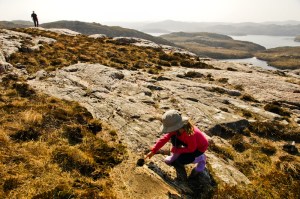
Creag Riabach, Ardmore Peninsula. Ginny Battson © 2012
-
The Weir
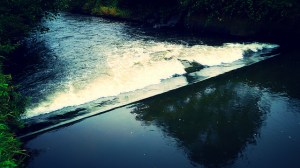
It has been my choice to sit by the weir, on the inside of my outstretched rain mac, each evening for a week now. No-one coerces me. And no-one calls me back in out of the rain. At first, I was captivated by the silky wave over a shallow slope of concrete. Then it was the shifting semblance of froth, striving and never achieving to journey back up the silk.
Autumn equinox has just passed, and if you’ve noticed, the air has cooled with expectation of changes to come. Rain drops are heavier, steelier, and the’ve been falling squarely in my face as I look up to admire bats hunting above the river.
So now I go out for the bats ~ pipistrelles I think, but I’ll need to monitor. There’s an elusive species here called Nathusius’, and their roosts are more difficult to find.
My daily bat-spotting probably hasn’t gifted me any favours; I’m suffering from a stiff bout of bronchitis. My raw lungs struggle to draw any kind of breath, slow or quick, without the hacking one might expect from a veteran tobacconeer (with pleurisy, for effect).
My state seems to have worsened through the night, and I can’t sleep at all. I’m feeling under pressure. Temperate Autumn is a time when life prepares for decay, trees simultaneously pushing out the small leaf buds as a gift of renewal* or a bat catching that last vital Summer moth before hibernation. It is a clever time. A canny time.
Imagine ~ someone takes the warmth and light away, what can we do but use our wherewithal to react and prepare for what’s next. We are like Autumn when placed slightly under pressure.
Beneath a good crowd of trees, here by the weir, the air becomes tangible with tiny chemicals released from leaves and stems which are being broken down by life’s heterotrophic decomposers. The fungi. There are complex mycelial languages we’re slowly beginning to understand but we humans, the youngest children in the family of nature, have much to learn. We know they send out signals to other creatures, detritivores. Come feast! The mix is both metabolic and earthy, as compounds are broken down to build anew.
As I gaze in awe among the higher vegetation, various gastropods, fabulous climbers, graze on the dead and dying, more visible to us than underground mycelial succession. I love slugs and snails. Their very being is like water crystallised to jelly. They glisten, most of all on dewy mornings, as they inch their way around a three dimensional world of wet, tall stems, soaked leaves and heavily-laden seed heads. And they gift us an important job each year, of clearing up the detritus (if we bother to understand them well enough, of course, we’d act more to protect them in return).
It can be tough for wildlife in the Autumn, finding enough food in a human-shaped landscape to fatten up through Winter. Thankfully, the blow for us humans has been softened by central heating, shopping malls and Autumnal colours! What’s more, we have the rich and peppered scent of fresh, fallen leaves to gently kick through. How much fun is that? Perhaps our mammal cousins appreciate this too, just for the hell of it.
So, this is my Autumn 2015. It is my own experience, in a new locale, with a new river (The Ely, which flows to man-made Cardiff Bay), and with a new non-human family, which I hope will adopt me. Sitting here in the soaking wet, I also hope to catch a falling leaf and make a wish. Last year I caught an ash leaf in Castle Wood. The year before, it was a beech leaf near Bredwardine Bridge. What will it be this year? I wonder.
~~~~~~~~~~~~~~~~
*Look for them, you’ll find them – leaf buds don’t generally appear in Spring, you know! Although they do remain dormant for a time before Spring warms them up, like cockles.
~~~~~~~~~~~~~~~~
Fascinating and beautiful report about mycelium, do click here
-
Some people say…
“Some people say they love animals and yet harm them nonetheless; I’m glad those people don’t love me.”
Marc Bekoff, The Animal Manifesto: Six Reasons for Expanding Our Compassion Footprint
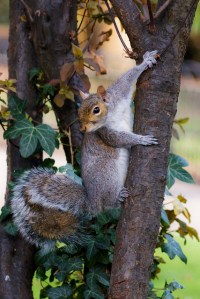
Grey Squirrel, Ginny Battson © 2012
-
"Ah, not to be cut off…"
“Ah, not to be cut off,
not through the slightest partition
shut out from the law of the stars.
The inner — what is it?
if not the intensified sky,
hurled through with birds and deep
with the winds of homecoming.”
― Rainer Maria Rilke, Ahead of All Parting: The Selected Poetry and Prose -
“Ah, not to be cut off…”
“Ah, not to be cut off,
not through the slightest partition
shut out from the law of the stars.
The inner — what is it?
if not the intensified sky,
hurled through with birds and deep
with the winds of homecoming.”― Rainer Maria Rilke, Ahead of All Parting: The Selected Poetry and Prose
-
To my daughter, on living with nature.
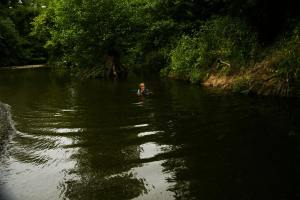
“How do we live with nature?”
~~~~~~~~~~
You asked me a question when you were a little girl. When I spoke of living with nature, I didn’t really mean living with the silverfish in the bathroom, jackdaws in the chimney or cellar spiders in the cupboard. Although they are, as you know, welcome! I’ll try to answer your question again, from my own point of view, now that you are older.
True understanding of nature is good, it’s about the best thing for you along with knowing you are loved. Never underestimate its relevance and resist those who laugh and disparage.
There are different kinds of understanding nature. One is most popular, but a falsehood, a selfish kind, which uses nature solely for utility and ego. This is not beautiful, and only ends in destruction of within and without. The other kind is an epiphany of all that is good about being human~ empathy, compassion and altruism ~ not only in a collective respect for nature but in a deep well of love for all fellow beings as unique and inherently valuable.
The false kind can and will make us ill, a broken ethic of selfishness, but the second, of selflessness, will unleash a strength in all of us, and reignite a dormant wisdom we lost somewhere in a crowd.
You’ll know when you truly understand the nature of nature, in that the scales will fall away from your eyes and you’ll feel the eternal energy that blazes through the biosphere across regions and time. We are all connected. Keep it travelling. If you hear even a whisper of this understanding, relish it. Share it. It is infectious to those who are susceptible. Don’t bother too much about those who are immune. And don’t worry about what you don’t know. Mystery is integral to the beauty. Embrace the unknown and then let it go, if needs be.
The purpose of nature and love is the very essence of beauty. Be confident that you can live a life full of this kind of beauty. Nothing else really matters. Design your decisions for this kind of life, as best you can.
Let nature know how you feel. Find the living things and tell them, in any way appropriate. They may not respond in our language, but they’ll hear and have languages all of their own. Listen and be literate in as many as possible. Herein, there is joy.
Knowing nature is gratitude. Remember your Ps and Qs.
When you are living a beautiful life, know that I understand the good feeling it brings. My life isn’t perfectly beautiful, whose is? But I feel it when it momentarily happens. Talk to me, you have my love.
Finally, life is lived best slowly and with enthusiasm for the small things, which are everything. You race very well in a pool full of water, my little swimmer, but there is no need to race for the pool of this knowledge. The most valuable tenets will be worth the wait, and will come to you if you keep an open heart.
To the end of the universe and back again,
Mum. xxx~~~~~~~~~
~~~~~~~~~
-
Castle Wood
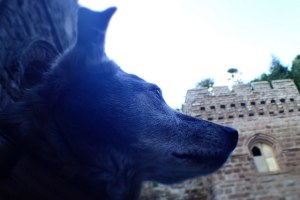
“Not all those who wander are lost.” – J. R. R. Tolkien
It has been an education living in a castle tower for the last eighteen months. Far from being grandiose, it’s been a small affair, a unit rented from the owners in a scheme of half a dozen, designed to equip them of income into an uncertain future. The costs of maintaining a castle must be great.*
The interior floor area has been tight, bijou, as the agents might describe. One of two small towers to the East of the main building, it’s been converted into two downstairs bedrooms and a high-ceiling living room/kitchen upstairs, with many stone steps in between. I’ve enjoyed the novelty of living here, although sandstone dust turns up in the most unlikely places, and my knees have taken a toll this week in lumping possessions down to an awaiting transit.
We’re leaving, you see, for new adventures. Another journey, another region, one of those switch points to reflect upon the road travelled and the course ahead. I have an array of memory boxes, literally, to either take along or give away. My heart says to keep, my head says to donate.
As a family, we move often, unplanned, but it’s just how things have turned out. Though I dream of living out my greying years in the same, familiar cottage with a chocolate-box garden, work is always there to leverage us out and along the road to somewhere new. Adventures, I am compelled to call them.
Here at the Tower, from my lofty, living room window, Castle Wood stands to the North, a startling skyline of tall canopy, green peaks and troughs. In amongst the branches, red kites, peregrines and buzzards alight, as well as tuneful passerines and agile squirrels. I’ve even seen a goshawk hunting redstarts.
Beneath the wood, across the tarmac, is the other mini-tower, the unconverted twin, with broken windows and a tawny owl sheltering beneath the roof beams. He often embarks on short forays into the soft woodland edge, and I call him Tony. I’ll miss him.
This other tower is like a parallel universe staged for me to observe; converted versus unconverted, present mirrored by the past. Weathering takes its toll on any standing object, even a castle tower made of solid, stone blocks.
Up to the side of the castellated owl-box is a boot-warn path, which we have made ourselves over the course of several months, the best kind of path. Low under the laurels, it climbs up through a wilder patch of recent secondary succession beneath small electric pylons. Eventually, it joins the managed and ‘marked red on the leasehold plan’ route through Castle Wood, which is strimmed relentlessly for the benefit of tenants. I wish it weren’t.
I’m now so familiar with this wood as I wander around with best buddy Ben, my collie-cross. In among a structural framework of native oaks, sweet and horse chestnuts, and beech, there are exotics such as mulberry, gingko, corsican pine, even a giant Californian redwood, and with an understory dominated by even more cherry laurel, rhododendron and green alkanet (flowers of bright blue). If one looks closely at some of the tree trunks, there are initials of Canadian military patients and Land Girls scratched into the bark, and stretched again with growth over the past seventy years. I wonder about these initials, the lives they represent, and their finality. There’s military history here, as the estate was requisitioned during World War II.
As you may have gathered, this is no fully functioning ancient woodland. It’s an island, with more exotics, invasives and human interventions than you can shake a stick at. But there are bats roosting in some of the veteran specimens, dragonflies hunting over a small Victorian reservoir and a number of bumblebees nesting in the ha-ha at the Northern edge.** Nature works its magic.
In the cavernous root plate of a windblown oak (not yet taken for timber, remarkably), hornets have been meticulously building a nest from the multi-tonal and far-flung tree species. I’d say they were at least two weeks crafting this intricate pastel-coloured paper home (a thing of beauty), with nothing more than their own spit and mandibles. A few days ago, they and their nest completely vanished. I’m hoping this was badger or fox rather than estate proprietor or woodland manager. Hornets are the gentle giants of the wasp world, and all they wish to do, just like us, is to flourish. I’ll miss them.
I am suddenly overwhelmed by a sense of grief. Perhaps this isn’t surprising. My late parents’ aged cat, Charlie, a dog-like statesman of a feline, was my treasured inheritance. He thoroughly enjoyed this woodland realm, but he died among the alkanet and bees, and so this was to be his eternal resting place. I’ll miss him.
Perhaps, these emotions are thoughts in process, like the very soils processing beneath my feet. Death and decay generate warmth and nutrients for new life yet to be. Leaving the Wye Valley churns the silt of my own river of time and loss. The mud soon clears with that constant flow of water from higher ground, revealing new woodland and rivers, new friends and, it must be said, the South Wales coast. Coast? Now, that really is going to be an adventure.
There is light.
~~~~~~~~~~~~~
* This current castle is far from ancient, the embodiment of narcissistic forbears of the current proprietors, who brought wealth back from East India only two hundred years ago. They were plant collectors, though not as extensive as that of the Banks of Hergest, Kington.
** It is presumed a very much older manor may have stood in the middle of what is now Castle Wood, with the ha-ha being all that remains.
-
CELEBRATING THE COMMON SPECIES – COMMON DARTER

Sympetrum striolatum ~ click the photo for more information…
-
I hold the most archaic values on earth…
I hold the most archaic values on earth … the fertility of the soul, the magic of the animals, the power-vision in solitude…. the love and ecstasy of the dance, the common work of the tribe.”
― Gary Snyder
Photo: Ginny Battson © 2012




 Seasonalight
You must be logged in to post a comment.