
Blog

  • Monknash and the Anthropocene

    23640991351_17b802c066_z

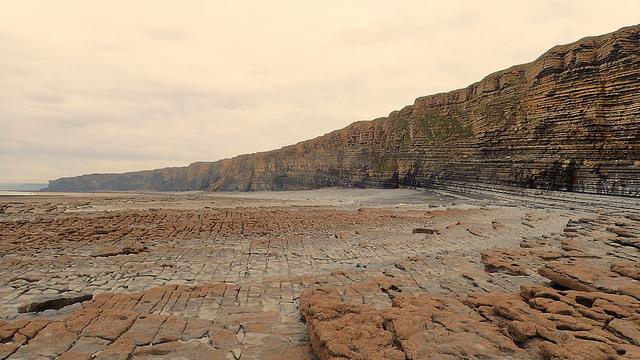
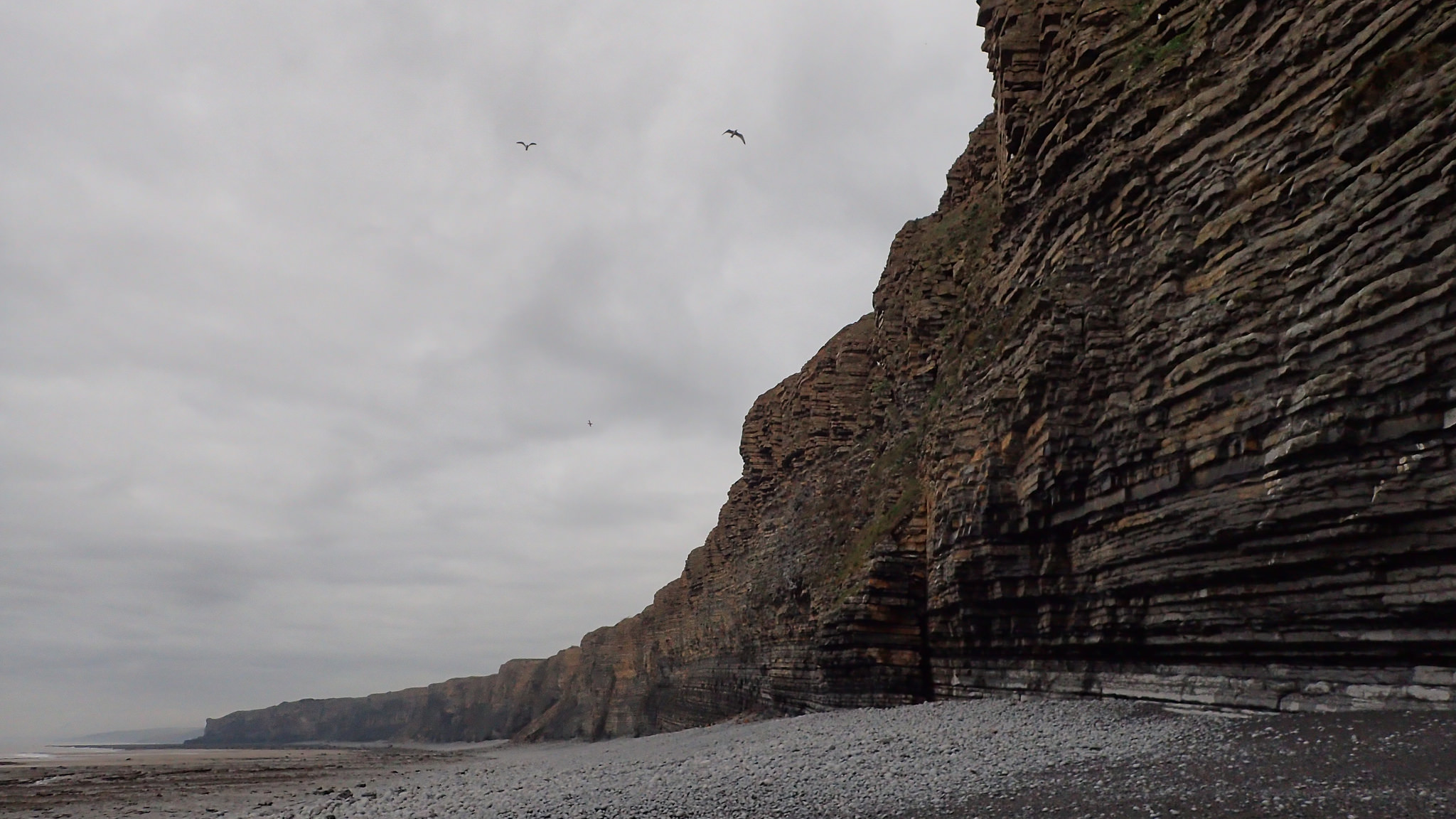
    I am at Monknash SSSI on the South Wales coast, protected for its abundance of special geology and rare species. A handful of humans and our canine companions are wandering the beach towards Cwm Marcross, beneath magnificent Liassic cliffs just West of Nash Point. We are all separate in our own worlds, though sharing the common experience of listening to the cackling of fulmars on narrow ledges and tracing our way along the shore. The steep, stratified layers of the cliffs are a rhythmic repetition of limestone and mudstone, and formed as a late Triassic desert was inundated by ocean. Molluscan faunas found here by paleontologists have provided a surprisingly detailed record of environmental history, particularly in rarer tufa limestone deposits. They mark the Boreal/Atlantic climatic transition around 8,000 years ago, when rising global temperatures meant further retreat of ice to the North and a rising sea.

    At that point in time, Mesolithic humans, dark skinned hunter-gatherers along with, perhaps, a few early settlers, populated what we now describe as Britain only sparsely. The sea had begun to inundate the good hunting grounds of the marshes, lakes and rivers of Doggerland, disconnecting us from mainland Europe. The Welsh shoreline had extended in plains out beyond what we see now as shore, into the Severn Sea (or in Welsh, Môr Hafren). These flatlands were also being swallowed by rising water levels. The newly forming coast would have provided an important source of marine food for early tribal groups, evidenced by middens of cockle and oyster shells discovered in estuarine zones. The temperate post-glacial climate would have encouraged more people to migrate and succeed.

    Some 3,500 years before that, at the end of the last Ice Age, marks the beginning of what the International Commission on Stratigraphy accept as the beginning of the Holocene epoch, the geological time period in which we now exist. Climate has been fairly stable over the Holocene, but things are changing rapidly.

    23615258042_97c9cda97d_z

    As one stands now between the cliffs and the shoreline, it’s as if time is materially trapped in the strata. Listen carefully, and you’ll hear the wind, rain and sea recounting narratives of antiquity, released in little whisps around you. There’s evidence here of glacial retreat, lost ecologies of marsh and woodland communities instead of the hinterland of farms we see today. And there are ancient human stories too, no doubt, the joys and struggles of life, to which I think we still may relate.

    Here on the edge of things, magic still dwells, as ever.

    23641188461_5c09ab60a7_z

    Today, intricate honeycomb worm reefs (Sabellaria alveolata), smother wave-cut platforms, thrusting out into long shore drift when tides are low. Their brown planes intersect the water with plumes of sea-spray, the final sigh of waves that may have begun thousands of miles away in the Atlantic Ocean. These are great hiding places for many other intertidal species, part of the reason they are formerly protected from human interference by Law.

    23096854673_d2b2551445_z


    It’s a wonder these reefs aren’t smashed to bits by erosion. But they remain firmly in tact, for now, the colonies of tiny worms resiliently rebuilding their feeding tubes with sand particles and shell remains at every chance.

    Sadly, if you look closely, you’ll see brightly coloured plastic rings, toys (some even with faces), bottles, caps and inexplicable mouldings that have become entwined deep in the honeycomb. I feed my hand into the reef to pull a few out, and fail. I can’t damage the reef. They are cemented, ensconced behind the living colonies, leeching out their chemicals as they slowly break down with unquantifiable consequences. It’s as if only another epoch of sea erosion and the loss of the worms themselves would ever see them gone.

    Moreover, I look around me and imagine worse to come. Oceanographers are now clear that anthropogenic climate change will bring the seas in higher and harder across these shores. More intense storms will wither the roots of all the rare life I observe today. The intertidal ecological zones will become permanently submerged and the cliffs will fall more rapidly back into the high energy waves that batter their foundations. Species will have to adapt as best they can.

    I feel ashamed of my own species. It’s all so unnecessary.

    23095302034_4e4715ee7f_z

    In altogether different parts of our Earth’s biosphere, as part of the International Commission on Stratigraphy, there are a number of academics scattered in universities worldwide who call themselves the Working Group on the Anthropocene. Anthropocene is a term first used by atmospheric chemist Paul Crutzen and ecologist Eugene Stoermer in 2000 to delineate a ‘present time interval’, yet to be fully sanctioned or determined, in which many geologically conditions and processes are profoundly altered by human activity. The evidence, however, is mounting.

    The Group plans to assemble later this year to decide whether the Anthropocene is to be ‘set in stone’. The case will be reviewed by the International Commission on Stratigraphy and, if approved, the new epoch will have to be ratified by the International Union of Geological Sciences before formal adoption.

    A paper published recently in Science provides further evidence of human impacts upon the lithosphere, the rigid outer part of our planet Earth. Various biogeochemical cycles have ensured our pollutants have reached far and wide. The plastic I find trapped today in the honeycomb worm reefs are only what I can see with my eyes. There are far more profound changes occurring beyond my senses that not only future geologists thousands of years from now (indeed, if our species has rallied), might discover in core samples and geochemical surveys, but modern Earth scientists are already uncovering.

    It appears there are indicators in recent lake sediments in Greenland, which distinguish them from the rest of the Holocene epoch,

    “The appearance of manufactured materials in sediments, including aluminum, plastics, and concrete, coincides with global spikes in fallout radionuclides and particulates from fossil fuel combustion. Carbon, nitrogen, and phosphorus cycles have been substantially modified over the past century.”

    Further,

    “unprecedented combinations of plastics, fly ash, radionuclides, metals, pesticides, reactive nitrogen, and consequences of increasing greenhouse gas concentrations. In this sediment core from west Greenland (69˚03’N, 49˚54’W), glacier retreat due to climate warming has resulted in an abrupt stratigraphic transition from proglacial sediments to nonglacial organic matter, effectively demarcating the onset of the Anthropocene.”

    Salutary stuff. There’s still much debate about the precise point in time the Anthropocene is supposed to have begun. Some argue it should be traced back to the Neolithic conversion from human hunter-gathering to farming, whilst others look to the more recent Industrial Revolution and the beginning of the fossil fuel era and greenhouse gas emissions. The Great Acceleration” since the 1950s, a period of exponential economic growth and consumption of resources, looks to be a prime candidate, and even the dropping of the first nuclear bomb in New Mexico 1945 has been suggested. The ‘Subatlantic’ is the current climatic age of the Holocene. It started at about 2,500 years ago, but the data sets will surely no longer be the norm as we move forward in time. Even in the UK, we are already facing what meteorologists describe as ‘unknown extremes’ in terms of climate volatility.

    Perhaps, by declaring a brand new geological epoch because of the impacts of one species, our own, the act itself will induce a re-imagining and re-forming of human-Earth relations. As a part of nature, we are cheating ourselves if we think our own dominion above all other life remains the route to living within our planetary boundaries instead of exceeding them as we do. We share one biosphere, we need to respect the precariousness of our situation, but remember our responsibilities to our evolutionary kin, both human and non-human.
    24005133349_be77527c0f_z

    Back to Monknash, and the tide is turning; significant, as it’s the second largest tidal range in the world after the Bay of Fundy in Eastern Canada. As I look West along the vista of cliffs, the light is fading to pink with the onset of evening, and it’s time for me to return home. I can’t help feeling that we could somehow learn from this coast as it reveals secrets of past changes whilst recording new climates and adapting species of today and into the future.

    This particular section is declared by Cardiff Vale Council to be unprotected from the onset of the sea, left to ‘natural’ processes which would have otherwise shaped our coasts for eons. We are, of course, part of nature, so our impacts may also be perceived as ‘natural’, though does not, I’d assert, make them anymore just. In other places nearby, where humans reside near current sea levels, there are, at least some plans afoot to provide defences and support. But we collectively haven’t the funds to fend off the mass of an expanding ocean for long. I can only hope that 2016 and the declaring of the Anthropocene Epoch will not go unnoticed for real change is now long overdue.

    ~~~~~~~~~~~~~~~
  • A brief response to Jan 2016 POST-Note Parliamentary Briefing on Policy.

    Here’s the latest briefing from the Parliamentary Office of Science and Technology, Houses of Parliament “Trends in Environment”

    If you care about nature, do read it.

    As per usual, the UK science community advising here FAIL to raise the importance of egalitarian environmental education. Nor do they seriously question growth economics supported by the Natural Capital Committee (who feature prominently, of course – yawn).

    Values mentioned are limited, if not singular! All in all, this document is typically reductionist, disappointing and foretells nothing new.

    The Conservatives won’t be driven to act in the radical way which is now needed to set us on a truly sustainable course. Electoral reform might give the electorate (and therefore non-human life) some hope, but of course POST are hardly in a position to suggest that!

    The state of the environment, and our relationship with it, is vastly more than about money. We really need to look at shifting value-sets in society, to look at our place within nature, and not without, and towards integrated action, compassion, love and reciprocity.

    What we absolutely need is a cross-disciplinary and inclusive approach, to bring everyone’s individual attention and energy to real change. Egalitarian ecoliteracy offers just this.


    ~~~~~~~~~~~~~


  • Rainer Maria Rilke, on difficulty….

    23723538335_d7a5ebb9f1_k

    Cliffs at Nash Point ~ Ginny Battson © 2015

    “If we only arrange our life in accordance with the principle which tells us that we must always trust in the difficult, then what now appears to us as the most alien will become our most intimate and trusted experience. How could we forget those ancient myths that stand at the beginning of all races, the myths about dragons that at the last moment are transformed into princesses? Perhaps all the dragons in our lives are princesses who are only waiting to see us act, just once, with beauty and courage”.

  • Learning from Frankl

    I can’t even begin to comprehend the collective grief, shock and injury in Paris right now. Pain and suffering are the cups that spilleth over. Refugees are drowning in the Mediterranean or freezing in the fields across the Balkans, flood victims suffer in Yemen, and those everywhere around the world subjected to extreme poverty, brutality and murderous war.

    This. This is beyond Paris.

    I’ve been reading Viktor Frankl’s “Man’s Search for Meaning” this week and I’m very glad I have. There are several vital points he makes about life in the Nazi death camps but opening the discussion broadly to facing any kind of adversity.

    Vitalia puncta ~
    1. Know what love really is, because love really is everything.

    2. Don’t dwell on expectations or outcomes without first finding meaning. Find genuine meaning to life, whatever that may be, and the human spirit remains strong in the face of daily adversity.

    Have these two things close to you and success, even happiness, is more likely to ensue.

    If those left amidst the wreckage of these latest horrific events have, or will find, both LOVE and MEANING, they may face the daily adversities ahead of them. They may survive and flourish once again and, perhaps, bring about a better world, so that we’ll also be inspired by their true understanding.

    This, the just revenge to all that is hate.

  • Equity in society and wildlife are inseparable. How?

    8391062668_3f71900d7b_z

    Robin Through Glass by  Ginny Battson

    I’m not sure many people consider the question of equity in human society in relation to how it impacts non-human lives in their complex interconnections. Equity, meaning justice and fairness for all with regard to equal rights to satisfy needs.

    This could be quite a monotone subject and, I’ll be honest, I don’t know how to colour it. But it needs explanation.

    Do we think a wealthy banker driving his Mercedes has anything to do with robin perched on our wooden bird table? Maybe the car is blue and robin’s breast is definitely ruddy – so, there we go, some colour already.

    Human economies depend on the life support system that is Nature, comprising living beings (including our own) and the elements or building blocks of life.

    The term social equity describes the idea that ALL members of the human community, local or global, have the same basic needs in order to flourish, and these are satisfied. I’ll also assume an inherent diversity built into the social system (not a safe assumption).

    ‘Needs’ are not the same as ‘wants’, and ‘wants’ may lead to excesses and further inequities.

    Even in asserting our basic needs, we have to make choices with consequences harmful to other species. This is inescapable. It is up to us to decide how to minimise the harm we do and eliminate cruelty (virtue ethics). This is why scientific and ethical discussions are so vital, to give some sense and order to the difference between what we may want and what we actually need.

    Intra-generational equity also describes justice among the present population. There is a natural justice to each human having the right to basic needs such as food, water, shelter, energy, access to land and sea in order to participate in the procuring of each, whilst at the same time gaining wellbeing from the mental, physical and spiritual side to this process. This includes downtime and rest (not to be overlooked).

    These ‘basics’ and the fulfilment of needs are socially facilitated by economic transactions, currently based on monetary value, but not always in human evolutionary history. They are also based on social interactions, from friends and family to institutional support, and natural resource consumption. All objects bought and sold are formed from constituent parts of the environment, from other species and from primary non-biological resources.

    When people have accumulated wealth, they tend to buy more stuff.

    When people live out their lives under duress in any of these areas, if not all (poverty), ethical concern for their immediate welfare and Rights overwhelms consideration for long term care of the environment, impeding planning for the future.

    And this is how it should be. Poverty is a SUFFERING. Compassion first.

    So what are the consequences?

    An inequitable market-driven economy embedded within society, with a widening gap between rich and poor and without fair redistribution of wealth, results in skewed utility of environment.

    We see further impingement upon wildlife, habitats, water, minerals, energy and intense welfare pressures on livestock, plus further wildlife conflict, in order to meet demands in volume and in cheaper food, et al.

    So now we begin to see a direct correlation between uneven distribution of wealth and wildlife.

    It’s further complicated by direct and indirect consequences of social and commercial decision-making in relation to:

    a. Accumulation of wealth and/or land as opposed to subsistence, to the detriment of equality.
    b. Marketing of products and services, which may be detrimental to the overall wellbeing of nature.
    c. Fiscal measures to favour the above.
    d. The heavy environmental cost of energy and supply transport
    e. Dealing (or not), with waste and emissions contributing to climate change.

    The wealthy Banker driving his blue Mercedes and the ruddy-breasted robin that perches on our bird table ARE interconnected.

    Even the wooden bird table is relevant (it was once a living tree and habitat to other species), and the food that is purchased and supplied to meet demand for it (as opposed to naturally foraged).

    How many people can afford to buy bird tables? Would they be necessary if there was enough natural foraging for wild birds? Perhaps, the Banker might also buy one hundred bird tables and copious sacks of food for robins. But what are the environmental costs over benefits? Maybe for some people, feeding the birds seems a need not simply a want, for mental wellbeing, and will find a way to do it even if they have little or no accumulated wealth. They might make their own bird tables and grow their own bird seed. Worthy intent!

    We are all interconnected. We all share Earth’s biosphere.

    Egalitarian ecological education is one of, if not, the biggest empowering factors we could bring to finding solutions. I’ll write again on this soon and have been invited to guest blog elsewhere.

    Further, there are domino effects of inequity from generation to generation. Current inequity can lead to future inequity and worse; conflict. Climate change will add to the burden.

    In my view, it’s high time we looked at other ways of organising our economies and redistributing wealth, setting something other than increased GDP Growth as the ultimate aim in future.

    For more information, check out steadystate.org and for a strong alternative. I signed the pledge. Maybe you’ll consider doing so too.

  • Mycelium of the forest floor. And love.

    8373620765_2c718e6e07_z

    It’s Autumn, and the fungal fruits of the woodland floor appear to resonate more than at any other time of year. To begin to understand fungal bodies and their place within ecosystems, one needs to imagine part of the world beneath the humus and deadwood, where the ‘hyphae’ grow. These are the living thread-like filaments primed to branch out into multicellular fungus. The resulting mat of subterranean mycelium, interconnecting with various plant roots, is a living gauze, where symbiotic mycorrhizal relationships exist between many forest beings. Think of a mycelium as a layer of blood vessels, keeping shape due to hydrodynamic pressure, with a flow of water and soluble nutrients journeying across cell membranes and the forest floor. Mycelium are the wood-wide web of woodland community consciousness.

    Hyphae grow from their very ‘finger’ tips, the softest exploration in finding a way to their next interconnection. In a lab, the direction of hyphal growth can be controlled by environmental stimuli, such as the application of an electric field. Hyphae can sense reproductive opportunities from some distance, and grow towards them. Hyphae can weave through a permeable surface to penetrate it.

    One may consider the human spirit of love a little like the hyphae, in sensing partners and finding ways to connect and exchange through layers. Love itself, of course, glows in many rainbow colours. Aristotle says love is composed of a single soul inhabiting two bodies. Mycelium may be the soul and unity of the forest, where not just two beings are united, but many, and for the love of the whole community.

    Consider our spiritual and mental growth, traveling from the outermost reaches of our minds to the tips of our fingers and beyond. From these outstretched fingers there may come others to warmly embrace and bring substance. Sometimes it takes courage simply to hold out one’s hand, with uncertainty and rejection looming. But when, in the eventual joining of those hands with like-mindedness, there are the deepest existential threads of human happiness (and suffering) to be interwoven.

    This Autumn, just when society’s disconnection from itself and from the rest of nature seems to have been framed, yet again, by the overwhelming monetary aspirations of Conservative Party Conference, one might find remedy in simply observing mycelium.

    Rilke says, “to love is good, too: love being difficult”.

    My goodness, it can be difficult. And just a little bit scary.

    Being in love often takes us beyond comfort, and into the fringes of the unknown. But if we risk nothing, we gain nothing. And the planet is need of it. There is a contract, however. With love there is the risk of loss. In union there are perhaps expectations and subordinations. If we see love, instead, as being something other than union, like the mycelium, a passage of consciousness, love may be THE call to act, and a light shining upon not ourselves but those we love. A selflessness.
    I was fortunate to have a brief discussion with philosopher A C Grayling at Hay Festival on the love of nature. I asked him, “can nature, or other living species, ever be our friends?” (I perceive much overlap between friendship and love). He appeared to revel in the question and agreed it is possible, with pets or wildlife. He then went further, to also included dead poets and musicians. There, he lost me. I’m big on metabolism. Some may agree with him. Poems and music may have a kind of lingering metabolism of their own and culturally embody the essence of love.

    But to love…. the love of life. All life.

    Love has had a tough time. It’s hounded out of politics as weak and sentimental. One could describe the rejection of love as an accumulation through time. It’s a pity. Marxian rejection of love was based on it as subjugating, an opiate for women, an instrument of suppression. We see this in materialist scientific world too, often, in an over-emphatic obsession with reducing cognitive bias. But to deny love exists is to deny its potential. Look at the woodland floor next time you are there. Touch the leaf litter gently with your finger tips. The Mycelium. And the love.

  • Pwllperran Farm

    Travel this ancient path beneath lichen.

    Worn rock and turf tell of this bow above
    where a boy once swung in sun and smiles.

    Further on, in a clearing above a gorge,
    reticent walls of hand hewn stone
    draw around a keen sycamore.

    We meet at this hearth, exposed by daylight
    where fire once warmed newborn lambs
    and a family name.

    Names were altered, time again
    by a Clergy mouth at a blissful wedding,
    or scribed by a mason in high Chapel lands.

    Summers were heaven, winters were hell
    and the oak fed the flames.
    Stand within these reclaimed walls.

    Brook roars as it tightens to cliffs and dying elms
    where a boy once slipped on ice and drowned.
    Leave a foot print in the moss, if you will.

    (poem exhibited in a small book of poetry at Derelict Sensations 2003, other artists listed here Derelict Sensations, St Pancras)

  • Why twisting vines do what they do…

    “it seems the actual direction of winding is determined by the plant’s genes and gravity. Japanese researchers (Hashimoto) found that a slight difference in the structure of tubulin, a microtubule protein in cells, determines the winding direction. They chemically mutated a straight growing vine until some wound left (CCW), then looked at the molecular structure of twisting. It was published in Nature. Other Japanese researchers (Kitazawa,et.al) found that gravity sensing cells are indespensible for shoot circumnutation (bending and bowing of the tip) and winding response. It was published in PNAS.So the plant knows which way is up from the gravisensing cells, then the tubulin structure determines whether it winds CW or CCW in relation to up”.

    Quinn Smithwick. Cambridge, MA, USA

    SONY DSC
    Twisting Vine. Ginny Battson © 2012
  • Corbyn and desire

    21693948399_2dcd4eee3d_q21258213154_cd7c903e3e_q

    Let me get this straight from the outset, I am not writing about sexual desire in relation to Jeremy Corbyn. Freudians may think sex and power are inextricable but it’s really beyond my remit, I know my limits. Instead, I’m thinking in terms of the want of political power.

    Corbyn’s inaugural speech as Labour Party leader this week flowed powerfully across the airwaves with a message of peace, compassion and affirmation of democracy. Just after the broadcast, on my way out for a walk with my dog Ben, I bumped into my new, elderly neighbour. She had listened to the speech, so I asked her what she thought of it.

    “Mayor of Toytown”, she replied, “with a big heart, of course. A generous man I think, but he’ll find that utterly impractical in leadership”.

    My neighbour, now retired, used to be deeply embedded in Cardiffian Welsh Labour, old style, before the rise of foundation-wearing Tony Blair (she met him once and observed he was wearing make-up ‘for the cameras’). This too before Plaid Cymru broke through some of the loyalty barriers with a renewed vigour towards socialism.

    “He will have to try to maintain that integrity, but I don’t know how he’s going to do it”, she added. We discussed the time of day, smiled and parted company. Ben chivvied me for his ramble.

    Despite negative punditry by the currently dispossessed Labour right, Corbyn’s speech was a clear rejection of the neoliberal Century of the Self, a breakthrough moment in the prospects of post-capitalism. I’ve since been pondering the man’s motivations. And also that old kernel of a quote by Lord Acton, on power corrupting and absolute power corrupting absolutely.

    Will Mr Corbyn, the pacifist, anti-war campaign veteran, self-sabotage simply by being leader?

    The rebellious aristocrat philosopher, Bertrand Russell, and fellow pacifist, spoke of human intent in his Nobel Lecture in 1950…

    “All human activity is prompted by desire. There is a wholly fallacious theory advanced by some earnest moralists to the effect that it is possible to resist desire in the interests of duty and moral principle. I say this is fallacious, not because no man ever acts from a sense of duty, but because duty has no hold on him unless he desires to be dutiful. If you wish to know what men will do, you must know not only, or principally, their material circumstances, but rather the whole system of their desires with their relative strengths.”

    I am imagining, if you’ve been in politics a long time, you might feel compelled, carpe diem style, to seek a leadership position to effect change. It appears generous that Corbyn now offers that opportunity back to the people of his party, moreover, the people of the nation if he’s given the chance.

    As I see it, power is not some kind of corrosive agent on a person’s integrity, but more a revealing light, bright, and searing into the depths of one’s character. The process of dying parallels, I am told by hospice workers, in that we all die differently. Our unique personalities, good and bad, somehow intensify as we are exposed to this light from which we cannot hide, just at a time before we fade to black. It is possible, perhaps, to learn in dying, hidden characteristics about ourselves which prime ministers, unless copiously narcissistic, have discovered way before the end of their time.

    Jeremy Corbyn is having the light shine upon him. He’s voicing an intention NOT to change as campaigner, and instead sees himself more as facilitator of political democratic process. Sections of the British press appear to be at a loss as to how to approach this. It’s novel. A leader, but not a leader? Instead, a facilitator of democratic process. The default reaction seems to be to diss him. Perhaps the same revelatory torch shines upon their formulaic practices (at last). I’m hoping for change ~ Corbyn the catalyst.

    From my own selfish perspective, I find this fascinating. As a student of ethics, I’m wondering whether to sideline my own stances in order to facilitate the pluralistic voices of the many. In many ways, I already try (Carving out the Hollows). I understand there would be inner conflicts and some may burn holes in my conscience. I would, on the positive side, retain my own voice in persuading, but not dictating, solutions. One hopes Mr. Corbyn retains his own voice throughout this process too. I like to listen to him as campaigner. He might persuade others with this new-found platform.

    Russell ushered forward a maxim, difficult to argue with… that we all act from the root of own desires, even if those personal desires may be altruistic as an end. At once, he outed a selfish vision of selfishness, where even in procuring a world full of empathy, compassion and altruism towards all life is little more than a deeply personal desire.

    Is Jeremy Corbyn bound by moral duty? Or do his inner desires facilitate a more peaceful, compassionate and democratic future and herald a stronger force? Sometimes our moral character is deemed compromised in order to achieve a specific consequence ~ lesser means to greater ends. It is then simply a question of how far we are content to compromise ourselves, and if we can live at ease with these decisions. We have conscience, and we have it for good reason.

    Anti-austerity, a voice for the poor, justice and peace, tangible action on environment…

    Above all, in Jeremy Corbyn, there appears to be an individual with a perfectly selfish desire that society becomes less selfish. A paradox, similar to the ‘tolerance paradox.’ (another blog). When next I meet my neighbour, I might just mention this to her. Whatever she says will make me smile. I like her and may report back.

    Next, less of desire and more of love…